Pharma Supply Chain Consulting: End-to-End Value Creation
Introduction
In the pharmaceutical industry, supply chains are no longer viewed as operational backbones that quietly support manufacturing and distribution. For large, global pharmaceutical enterprises, the supply chain is a strategic asset that directly influences regulatory compliance, product availability, revenue protection, and corporate reputation. Increasing regulatory scrutiny, globalized sourcing models, complex biologics portfolios, and heightened patient expectations have transformed supply chain performance into a board-level concern. Pharma supply chain consulting has emerged as a critical enabler for organizations seeking to strengthen resilience, optimize performance, and align supply chain operations with enterprise strategy.
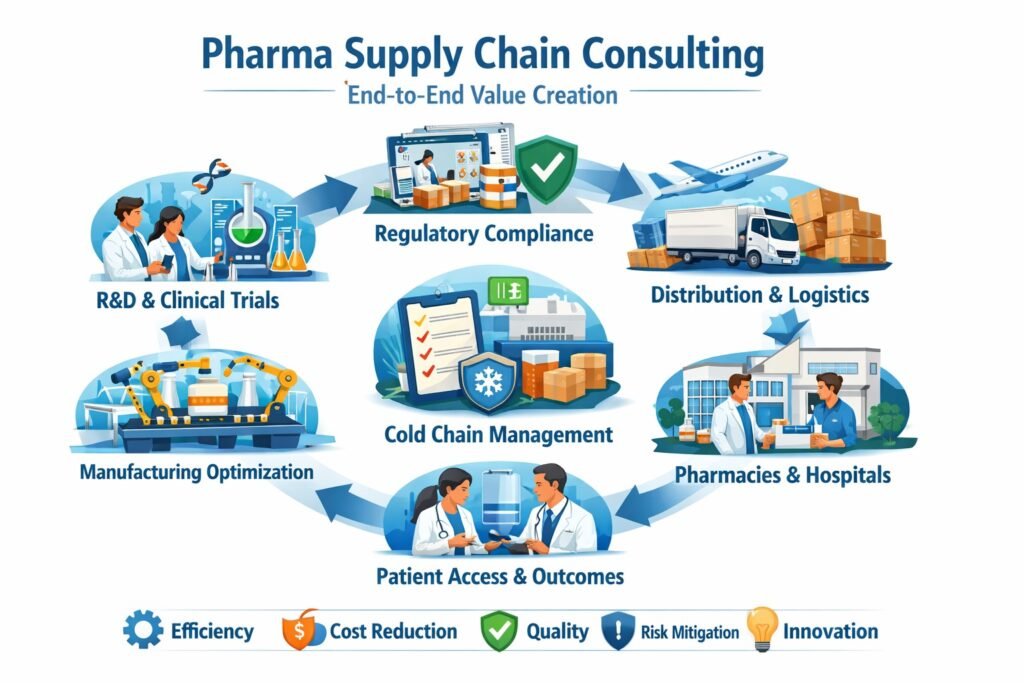
Enterprise pharmaceutical supply chains operate across a highly complex ecosystem that spans research and development, clinical trials, commercial manufacturing, distribution, and post-market surveillance. Each stage introduces risk, cost, and compliance exposure. Disruptions can result in delayed product launches, regulatory action, stockouts of life-saving therapies, and significant financial loss. Pharma supply chain consulting supports organizations in navigating this complexity by applying structured methodologies, advanced analytics, digital enablement, and governance frameworks that elevate supply chain maturity. Rather than focusing on isolated efficiency gains, modern consulting engagements address the end-to-end value chain, enabling pharmaceutical enterprises to achieve sustainable, compliant, and scalable supply chain performance.
The Strategic Importance of Supply Chain Consulting in Pharma
For large pharmaceutical organizations, supply chain decisions are inseparable from corporate strategy. Choices related to sourcing, manufacturing footprint, inventory policies, and distribution models have long-term implications for cost structure, speed to market, and regulatory exposure. Pharma supply chain consulting provides an objective, enterprise-wide perspective that helps leadership teams evaluate these decisions holistically rather than through functional silos.
Consultants bring cross-industry benchmarks, regulatory insight, and transformation experience that internal teams often lack due to operational focus or organizational constraints. This external perspective allows pharmaceutical enterprises to challenge legacy practices, identify structural inefficiencies, and redesign supply chains to support future growth. Consulting engagements often serve as catalysts for broader transformation initiatives, aligning supply chain strategy with corporate objectives such as geographic expansion, portfolio diversification, and digital transformation.
Regulatory Complexity and Compliance as a Core Driver
Regulatory compliance is a defining characteristic of pharmaceutical supply chains. Organizations must adhere to Good Manufacturing Practice, Good Distribution Practice, data integrity standards, and country-specific regulations across every node of the supply network. Failure to comply can result in product recalls, warning letters, import bans, and reputational damage.
Pharma supply chain consulting plays a critical role in embedding compliance into supply chain design and execution. Consultants assess regulatory risk across suppliers, manufacturing sites, logistics partners, and data systems. They help organizations standardize quality processes, strengthen supplier qualification programs, and implement governance structures that support consistent compliance across global operations. By integrating compliance into planning, sourcing, and execution models, consulting-led transformations reduce regulatory exposure while enabling operational flexibility.
Supply Chain Resilience and Risk Management
Recent global disruptions have exposed vulnerabilities in pharmaceutical supply chains, particularly those dependent on single-source suppliers, extended global lead times, or limited inventory buffers. For enterprise organizations, resilience is no longer a secondary consideration but a strategic priority.
Pharma supply chain consulting supports resilience by enabling organizations to identify and mitigate structural risks. This includes assessing supplier concentration, geographic exposure, logistics dependencies, and capacity constraints. Consultants help enterprises design diversified sourcing strategies, optimize safety stock policies, and implement scenario-based planning capabilities. Advanced risk management frameworks allow organizations to anticipate disruptions, evaluate trade-offs, and respond decisively without compromising compliance or patient supply.
Digital Transformation of the Pharma Supply Chain
Digital enablement is a cornerstone of modern pharma supply chain consulting. Legacy systems, fragmented data, and manual processes limit visibility and slow decision-making in large organizations. Consultants support enterprises in defining and executing digital roadmaps that enhance transparency, agility, and control.
Key focus areas include advanced planning systems, real-time inventory visibility, supplier performance analytics, and predictive risk monitoring. Digital twins, artificial intelligence, and machine learning are increasingly applied to demand forecasting, capacity planning, and disruption response. Pharma supply chain consulting ensures that digital investments are aligned with business outcomes rather than deployed as isolated technology initiatives. The result is a connected, data-driven supply chain that supports proactive management and continuous improvement.
Operating Model Design and Organizational Alignment
Many pharmaceutical organizations struggle with fragmented supply chain operating models that have evolved organically through mergers, acquisitions, and geographic expansion. Inconsistent roles, duplicated processes, and unclear decision rights undermine performance and accountability.
Pharma supply chain consulting addresses these challenges by redesigning operating models to support enterprise scale. This includes defining global versus local responsibilities, standardizing processes, and establishing governance forums that enable effective decision-making. Consultants help organizations align supply chain structures with strategic priorities, ensuring that accountability for performance, risk, and compliance is clearly defined. A well-designed operating model enhances collaboration across functions such as procurement, manufacturing, quality, and commercial operations.
Supplier Strategy and Strategic Sourcing
Supplier relationships are critical to pharmaceutical supply chain performance. Active pharmaceutical ingredients, excipients, packaging components, and specialized services are often sourced from a limited pool of qualified suppliers. Managing these relationships requires a balance between cost efficiency, quality assurance, and risk mitigation.
Pharma supply chain consulting supports the development of strategic supplier management frameworks. This includes supplier segmentation, performance management, risk assessment, and collaboration models. Consultants help enterprises move beyond transactional sourcing toward long-term partnerships that support innovation, capacity assurance, and continuous improvement. Effective supplier strategies enhance supply continuity while strengthening negotiation leverage and compliance oversight.
Inventory Optimization and Working Capital Management
Inventory represents a significant investment for pharmaceutical enterprises, particularly those managing complex product portfolios with varying shelf lives and demand patterns. Excess inventory ties up capital and increases obsolescence risk, while insufficient inventory threatens product availability and regulatory commitments.
Pharma supply chain consulting enables organizations to optimize inventory policies across the value chain. Consultants apply advanced analytics to balance service levels, lead times, and variability. This includes optimizing safety stock, improving demand planning accuracy, and aligning inventory strategies with product lifecycle stages. Improved inventory management delivers measurable financial benefits while supporting reliable patient supply.
Change Management and Capability Building
Supply chain transformation in pharmaceutical enterprises requires more than process redesign and technology implementation. Sustainable change depends on leadership alignment, workforce capability, and cultural adoption. Resistance to change, skills gaps, and competing priorities often undermine transformation efforts.
Pharma supply chain consulting integrates change management and capability building into transformation programs. This includes leadership engagement, communication strategies, training programs, and performance management alignment. Consultants help organizations develop internal capabilities that sustain improvements beyond the engagement. By building supply chain maturity, enterprises reduce dependency on external support and strengthen long-term performance.
Measuring Value and Business Outcomes
Enterprise leaders increasingly demand clear evidence of value from consulting engagements. Pharma supply chain consulting emphasizes measurable outcomes that align with strategic objectives. These may include improved service levels, reduced supply disruptions, enhanced compliance metrics, working capital improvements, and faster time to market.
Consultants establish performance baselines, define key performance indicators, and implement governance mechanisms to track progress. Transparent measurement builds confidence among stakeholders and ensures that supply chain transformation delivers tangible business impact. Over time, these outcomes contribute to improved enterprise resilience, competitiveness, and shareholder value.
Industry-Specific Nuances in Pharmaceutical Supply Chains
Pharmaceutical supply chains differ significantly from those in other industries due to product sensitivity, regulatory oversight, and patient impact. Cold chain management, serialization requirements, controlled substances handling, and clinical supply logistics introduce unique challenges.
Pharma supply chain consulting incorporates these industry-specific nuances into solution design. Consultants leverage deep regulatory knowledge and sector experience to ensure that transformation initiatives are both compliant and practical. This industry focus is essential for large organizations operating across multiple therapeutic areas and regulatory jurisdictions.
Practical Guidance for Enterprise Leaders
Enterprise leaders considering pharma supply chain consulting should focus on strategic alignment rather than isolated problem-solving. Successful engagements begin with a clear understanding of corporate objectives, risk appetite, and transformation ambition. Leaders should prioritize end-to-end visibility, governance integration, and capability development over short-term cost reduction alone.
Selecting consulting partners with proven pharmaceutical experience, regulatory expertise, and transformation credentials is critical. Clear scope definition, executive sponsorship, and performance measurement ensure that consulting engagements deliver sustainable value. When approached strategically, pharma supply chain consulting becomes a lever for enterprise transformation rather than a tactical intervention.
Conclusion
Pharma supply chain consulting has become an essential capability for large pharmaceutical organizations navigating an increasingly complex and regulated operating environment. As supply chains evolve into strategic assets, enterprises must move beyond incremental improvements toward holistic, data-driven, and resilient operating models. Consulting engagements provide the expertise, structure, and external perspective needed to accelerate this evolution.
By addressing regulatory compliance, risk management, digital enablement, and organizational alignment, pharma supply chain consulting enables enterprises to strengthen performance across the value chain. The result is a supply chain that supports innovation, protects patient access, and delivers sustainable enterprise value. For pharmaceutical leaders, investing in supply chain consulting is not simply an operational decision but a strategic commitment to long-term resilience and competitive advantage.
Frequently Asked Questions
What is pharma supply chain consulting?
Pharma supply chain consulting is a specialized advisory service that helps pharmaceutical enterprises design, optimize, and govern end-to-end supply chain operations. It focuses on aligning supply chain strategy with corporate objectives while addressing regulatory compliance, risk management, digital enablement, and global operating complexity at enterprise scale.
How does pharma supply chain consulting differ from general supply chain consulting?
Pharma supply chain consulting is tailored to the unique regulatory, quality, and patient safety requirements of the pharmaceutical industry. Unlike general supply chain consulting, it incorporates deep expertise in Good Manufacturing Practice, Good Distribution Practice, serialization, cold chain management, and regulatory inspections, ensuring solutions are compliant as well as operationally effective.
When should a pharmaceutical organization engage supply chain consultants?
Pharmaceutical enterprises typically engage supply chain consultants during periods of transformation or heightened risk. Common triggers include mergers and acquisitions, global expansion, persistent supply disruptions, regulatory findings, digital transformation initiatives, or the need to improve resilience and working capital performance across complex portfolios.
What outcomes can large pharmaceutical organizations expect?
At enterprise level, outcomes often include improved supply continuity, reduced regulatory risk, stronger supplier governance, optimized inventory and working capital, enhanced end-to-end visibility, and faster decision-making. Over time, these improvements support improved patient access, financial performance, and organizational resilience.
How do consultants support regulatory compliance without slowing operations?
Consultants embed compliance into supply chain design rather than treating it as a separate control layer. By standardizing processes, strengthening governance, and leveraging digital tools for monitoring and documentation, organizations can maintain regulatory compliance while improving speed, transparency, and operational efficiency.
Does pharma supply chain consulting focus more on strategy or execution?
Effective engagements address both. Strategy defines the target operating model, risk posture, and digital roadmap, while execution ensures changes are implemented, adopted, and sustained. For large enterprises, consultants often support multi-year transformation programs that integrate strategy, technology, process redesign, and capability building.
How does pharma supply chain consulting support digital transformation?
Consultants help pharmaceutical organizations identify high-value digital use cases, select appropriate technologies, and integrate them into existing landscapes. This includes advanced planning systems, predictive analytics, supplier performance platforms, and real-time visibility tools, all aligned with regulatory and data integrity requirements.
What role does supplier management play in consulting engagements?
Supplier strategy is a central focus. Consulting engagements often include supplier segmentation, qualification frameworks, performance management, and risk monitoring. This helps enterprises reduce dependency risks, strengthen quality oversight, and build long-term partnerships that support innovation and capacity assurance.
How is success measured in pharma supply chain consulting?
Success is measured through clearly defined enterprise-level metrics such as service levels, supply disruption frequency, compliance indicators, inventory turns, working capital improvement, and decision cycle times. Strong governance ensures progress is tracked and value realization is transparent to executive stakeholders.
Is pharma supply chain consulting relevant for organizations with mature operations?
Yes. Even mature pharmaceutical organizations face evolving regulatory expectations, technology advancements, and market pressures. Consulting provides external perspective, benchmarking insight, and transformation expertise that help mature enterprises continuously improve, adapt, and sustain competitive advantage.
Hashtags
#PharmaSupplyChain #LifeSciencesConsulting #EnterpriseOperations #SupplyChainTransformation #PharmaceuticalIndustry
Explore more great insights project www.projectblogs.com
Learn key Project Management techniques with these detailed Blogs:
https://pmresourcehub.com/marketing-procurement-how-to-streamline-processes-for-greater-success/
https://pmresourcehub.com/word-document-researcher-transforming-corporate-documentation/
https://pmresourcehub.com/simple-project-why-keeping-projects-simple-can-bring-success/
https://pmresourcehub.com/clickup-project-management-how-clickup-enhances-project-delivery/
https://pmresourcehub.com/rasic-how-rasic-enhances-collaboration-and-improves-business-efficiency/
https://pmresourcehub.com/retail-management-system-definition-key-insights-for-businesses/
https://pmresourcehub.com/ai-governance-continuous-improvement-the-evolution-of-ai-governance/
https://pmresourcehub.com/nursing-stand-up-meeting-template-a-user-guide/
https://pmresourcehub.com/productivity-calculator-a-comprehensive-guide-for-business-leaders/
https://pmresourcehub.com/development-goals-examples-best-practices-for-high-performance/
https://pmresourcehub.com/construction-company-business-plan-how-to-write-one/
https://pmresourcehub.com/pipedrive-vs-monday-making-the-right-choice/
https://pmresourcehub.com/voice-of-the-customer-training-enhancing-customer-insights/
https://pmresourcehub.com/why-is-punctuality-important-in-the-construction-industry-key-reasons/
https://pmresourcehub.com/is-china-number-one-how-innovation-is-changing-global-markets/
https://pmresourcehub.com/pharma-supply-chain-consulting-end-to-end-value-creation/