
Stakeholder Influence Assessment – Free Download Word
Introduction to Stakeholder Influence
In the previous templates, we identified who the stakeholders are (The Register) and assessed their level of authority and interest (The Power–Interest Matrix). However, organizational dynamics are rarely linear. An organizational chart tells you who has authority, but it rarely tells you who has influence.
Authority is the right to give orders. Influence is the ability to change minds. These are two very different forces. A Junior Developer might have zero authority to approve a budget, yet they might be the single most influential voice in the ear of the CTO regarding technical choices. If you ignore the Junior Developer because they are “low on the org chart,” you might find your technical proposal rejected by the CTO without understanding why.
The Stakeholder Influence Assessment is an advanced project management tool. It maps the invisible lines of communication, trust, and persuasion that exist within an organization. It seeks to answer the question: Who listens to whom?
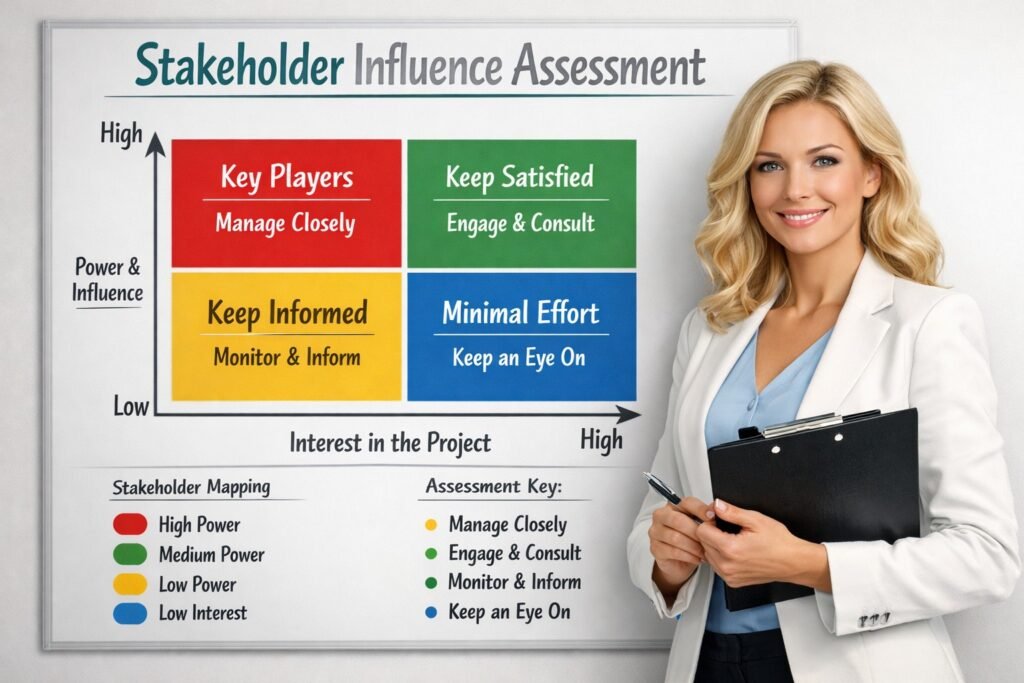
This template guides you through the process of conducting a “Network Analysis” of your stakeholders. It helps you identify the “Opinion Leaders,” the “Gatekeepers,” and the “Connectors.” By understanding these dynamics, you can navigate office politics with sophistication, ensuring that your message reaches the right people through the most effective channels.
Section 1: Distinguishing Power vs. Influence
Guidance for Completion
To complete this assessment effectively, you must first intellectually separate “Power” from “Influence.” This section is for your internal analysis to categorize stakeholders correctly.
Definitions
- Power (Formal Authority): This is derived from a position. It is static. It is written in a job description. A manager has power over a subordinate because the company says so.
- Influence (Informal Authority): This is derived from relationships, expertise, or personality. It is fluid. It is earned. A subject matter expert has influence because people trust their knowledge.
The Assessment Task
Review your “High Power” stakeholders from Template 6. Now, ask: Who influences them?
Review your “Low Power” stakeholders. Ask: Do any of them have outsized influence on the decision-makers?
Draft Example
Stakeholder: The CEO’s Executive Assistant.
- Power Score: Low (Cannot sign checks or approve scope).
- Influence Score: Extremely High.
- Reasoning: She controls access to the CEO. She summarizes documents for the CEO. If she says “This project seems disorganized,” the CEO believes her. She is a critical “Gatekeeper” influencer.
Section 2: Categorizing the Sources of Influence
Guidance for Completion
Not all influence comes from the same source. Social psychologists (specifically French and Raven) identified five “Bases of Power/Influence.” Categorizing your stakeholders by type of influence helps you determine how to engage with them.
The Five Types
- Legitimate Influence: Based on rank (e.g., The VP). You influence them by following protocol.
- Reward Influence: Based on the ability to give perks (e.g., The HR Director). You influence them by aligning with their reward structures.
- Coercive Influence: Based on fear or punishment (e.g., The Compliance Officer). You influence them by proving safety and adherence to rules.
- Expert Influence: Based on knowledge (e.g., The Senior Architect). You influence them with data and technical logic.
- Referent Influence: Based on personality and likeability (e.g., The charismatic Team Lead). You influence them by building a personal relationship.
Analysis Grid
Create a mapping for your key stakeholders.
- Name: Dr. Smith (Chief Scientist).
- Source of Influence: Expert.
- Implication: Do not try to “pull rank” on her. Win her over with data, peer-reviewed studies, and technical rigor.
Section 3: Mapping the Influence Network (The “Spiderweb”)
Guidance for Completion
This is the core of the template. You are essentially drawing a map of the social network. Who talks to whom at the water cooler? Who goes for lunch together? Who worked together at a previous company?
The “Who Listens to Whom” Map
Identify the directional flow of advice. This is often asymmetrical. Person A might listen to Person B, but Person B does not listen to Person A.
Mapping Questions
- The Mentor Connection: Is a junior stakeholder being mentored by a senior executive?
- The History Connection: Did the Project Sponsor and the Vendor Sales Rep work together ten years ago?
- The Social Connection: Do the Marketing Director and the IT Director play golf together?
Draft Example
Target Decision Maker: The CFO (We need him to approve the budget).
Direct Approach: Failed. He is too busy.
Influence Path:
- Identify that the CFO trusts the Head of Audit implicitly.
- The Head of Audit is worried about “Compliance Risk.”
- Strategy: We will present the project to the Head of Audit, focusing on how our new software reduces compliance risk.
- Result: The Head of Audit tells the CFO, “You should fund this; it makes us safer.” The CFO approves the budget.
Section 4: Directional Influence Assessment
Guidance for Completion
Influence flows in multiple directions. Understanding the vector of influence helps you predict how information will travel through the organization.
The Four Directions
- Upward Influence: Can this person sway senior leadership? (e.g., A trusted advisor).
- Downward Influence: Can this person rally the troops? (e.g., A union representative or a respected team lead).
- Sideward Influence: Can this person persuade their peers in other departments? (e.g., A cross-functional liaison).
- Outward Influence: Can this person sway public opinion or customers? (e.g., A media spokesperson).
Draft Example
Stakeholder: Sarah Jones (User Acceptance Testing Lead).
- Direction: Strong Downward Influence.
- Analysis: Sarah is beloved by the call center staff. If Sarah says the new system is “clunky,” 500 call center agents will revolt. If she says it is “cool,” they will adopt it.
- Action: Make Sarah a “Project Champion.” Give her early access so she feels special and advocates downward to the staff.
Section 5: The “Velocity” of Influence
Guidance for Completion
Some stakeholders are slow to form opinions, but once they do, they are immovable. Others are quick to judge and quick to share. This section assesses the speed at which a stakeholder can impact the project environment.
Velocity Ratings
- High Velocity: The “Town Crier.” They hear a rumor and immediately post it on the internal chat or tell five people. They are dangerous if they have misinformation.
- Medium Velocity: They process information and discuss it in structured meetings.
- Low Velocity: They hoard information or are slow to react.
Strategy for High Velocity Influencers
You must feed the “High Velocity” influencers with accurate, positive information first. If you delay, they will fill the void with rumors.
- Tactic: “Pre-brief” the Town Criers 30 minutes before a major announcement. Say, “I wanted you to know first.” They will then spread your message efficiently.
Section 6: Proximity and Access Analysis
Guidance for Completion
Influence is often a function of proximity. In a hybrid or remote world, “digital proximity” matters too. This section assesses how close the stakeholder is to the center of the action.
Physical/Digital Proximity
- The “Desk-Side” Influencer: Do they sit next to the boss? (High influence due to frequent, casual interactions).
- The Remote Stakeholder: Are they in a different time zone? (Risk of exclusion and reduced influence, or risk of feeling alienated).
- The “Inner Circle”: Are they on the invite list for the “Monday Morning Strategy Call”?
Draft Example
Stakeholder: Regional VP (West Coast).
Project HQ: New York (East Coast).
Risk: The Regional VP has high formal power but low proximity. Decisions are being made in the New York hallway without him.
Mitigation: The Project Manager must act as the bridge. Schedule a specific “West Coast Sync” to ensure the Regional VP does not feel sidelined and use his power to block the project later.
Section 7: Influence Clusters and Coalitions
Guidance for Completion
Stakeholders rarely act alone. They form tribes, clusters, or coalitions. This section asks you to identify these groups. If you anger one member of the coalition, you likely anger them all. Conversely, if you win over the leader of the coalition, you win them all.
Identifying the Clusters
Look for voting blocks.
- The “Old Guard”: Long-serving employees who resist change.
- The “Innovators”: New hires who want to disrupt everything.
- The “Finance Block”: A group that prioritizes cost over functionality.
Draft Example
Cluster: The Legacy Software Users.
Members: 15 senior clerks in the processing department.
Leader: Bob (The Shift Supervisor).
Analysis: The clerks will not adopt the new tool unless Bob blesses it. They vote as a block.
Strategy: Do not try to convince the 15 clerks individually. Spend 100% of your effort convincing Bob. The cluster will follow the leader.
Section 8: The Influence Strategy Matrix
Guidance for Completion
Now that you have analyzed the web of influence, you must define strategies. This is the “So What?” section. How do you leverage this information to secure project success?
Strategy 1: The “Champion” Model
Identify a stakeholder with High Influence and High Support. Deputize them. Ask them to sell the project when you are not in the room.
- Action: “Ask the Marketing Director to mention the project in her next All-Hands meeting.”
Strategy 2: The “Inception” Model
Used for stakeholders who do not like being told what to do (e.g., Senior Technical Architects). You need to make them think the idea was theirs.
- Action: “Present the problem to the Architect. Ask for their advice. Guide them gently toward your solution. When they suggest it, praise them for the brilliant idea.”
Strategy 3: The “Echo Chamber” Model
Used for indecisive decision-makers. Ensure they hear the same positive message from three different influencers they trust.
- Action: “Brief the CFO, the COO, and the Head of Sales. When the CEO asks any of them, they all say ‘It’s a good project.’ The CEO feels safe approving it.”
Section 9: Managing Negative Influencers (The Saboteurs)
Guidance for Completion
Some influencers will be against your project. They may perceive it as a threat to their job, their status, or their preferred way of working. You must identify them and have a containment plan.
Types of Negative Influencers
- The Sniper: Criticizes the project quietly in private meetings.
- The Tank: Openly aggressive and confrontational in public meetings.
- The Victim: Complains that the project is “too hard” or “unfair” to gain sympathy.
Mitigation Strategies
- For the Sniper: Shine a light on them. Force them to voice their concerns in a public forum where you can address them with data. “Bob, I heard you had concerns about the timeline. Can you share them with the group so we can solve them?”
- For the Tank: Do not counter-attack. Stay calm. Use the “Broken Record” technique. “I understand your frustration. However, the data suggests…”
- For the Victim: Offer training and support. Remove the excuse that it is “too hard.”
Section 10: Monitoring Influence Shifts
Guidance for Completion
Influence is even more fluid than power. A reorganization, a rumor, or a failed deliverable can change the influence map overnight.
Trigger Events for Re-Assessment
- New Executive Hire: A new leader brings their own “Inner Circle.” The old influencers may lose status.
- Project Failure: If a milestone is missed, the “Detractors” gain influence. “I told you it wouldn’t work.”
- Project Success: If a milestone is hit, the “Champions” gain influence.
Review Cadence
Revisit this assessment quarterly. Ask: “Has anyone lost their ear of the King?” or “Is there a rising star we need to engage?”
Section 11: Assessing External Influencers
Guidance for Completion
Not all influence is internal. Sometimes the biggest sway comes from outside the building.
External Categories
- Regulators: They have Coercive Influence (fines).
- Key Customers: They have Reward Influence (revenue).
- Consultants/Analysts: (e.g., Gartner, Forrester). If a Gartner report says “Technology X is dead,” your CEO might kill the project based on that external influence.
Draft Example
Scenario: We are building a custom CRM.
External Influence: A Gartner report is released saying “Custom CRMs have a 70% failure rate; buy off-the-shelf instead.”
Impact: The CEO reads this and panics.
Mitigation: You must prepare a counter-argument showing why our specific case is an exception to the general industry trend.
Conclusion
The Stakeholder Influence Assessment is the project manager’s radar system. It allows you to see the invisible structures that actually run the organization. While the Organizational Chart shows how things should work, this Influence Assessment shows how things actually work.
By completing this template, you move from being a “Project Administrator” (who simply tracks tasks) to a “Project Leader” (who navigates complex social systems). You understand that to get a decision made, you often have to lobby the decision-maker’s trusted advisor rather than the decision-maker themselves. You understand that to get the team to work overtime, you need the buy-in of the informal “Team Leader,” not just the official manager.
Use this document with extreme discretion. Like the Stakeholder Register, it contains sensitive political intelligence. It acts as your private playbook. When you encounter resistance, consult this map. Find the path of least resistance. Find the person who holds the key to the person you need to unlock.
Ultimately, projects are human endeavors. Humans are social creatures influenced by trust, fear, friendship, and tribalism. This assessment allows you to work with human nature rather than fighting against it.
Meta Description
A template for assessing stakeholder influence networks. Maps informal authority, opinion leaders, and relationship dynamics to navigate organizational politics effectively.
Discover More great insights at www.pmresourcehub.com