
Stakeholder Power Interest Matrix – Free Download Word
Introduction to the Power Interest Matrix
In the previous template, we established the Stakeholder Register. That document serves as the comprehensive “phone book” of your project. It lists everyone who matters. However, a list is flat. It treats the CEO and the summer intern as equal rows in a spreadsheet. In the reality of complex project management, this flat view is insufficient for effective strategy. You have limited time, limited budget, and limited political capital. You cannot treat every stakeholder equally. If you attempt to communicate with everyone with the same intensity, you will burn out, and you will annoy your senior leaders with unnecessary details.
The Stakeholder Power–Interest Matrix (also known as the Power/Influence Grid) is the primary tool used to prioritize your engagement efforts. It is a visual mapping exercise that places every stakeholder into one of four distinct quadrants based on two specific variables: how much power they possess to shape the project and how interested they are in the project’s details or outcomes.
By plotting stakeholders on this grid, the Project Manager can instantly visualize where the “center of gravity” lies. It transforms a chaotic list of names into a clear strategic battle map. It tells you who you need to have lunch with every week and who you only need to email once a month. It tells you who can be your greatest champion and who poses the greatest risk if ignored.
Stakeholder Power Interest Matrix – Free Download Word – Click the blue button above
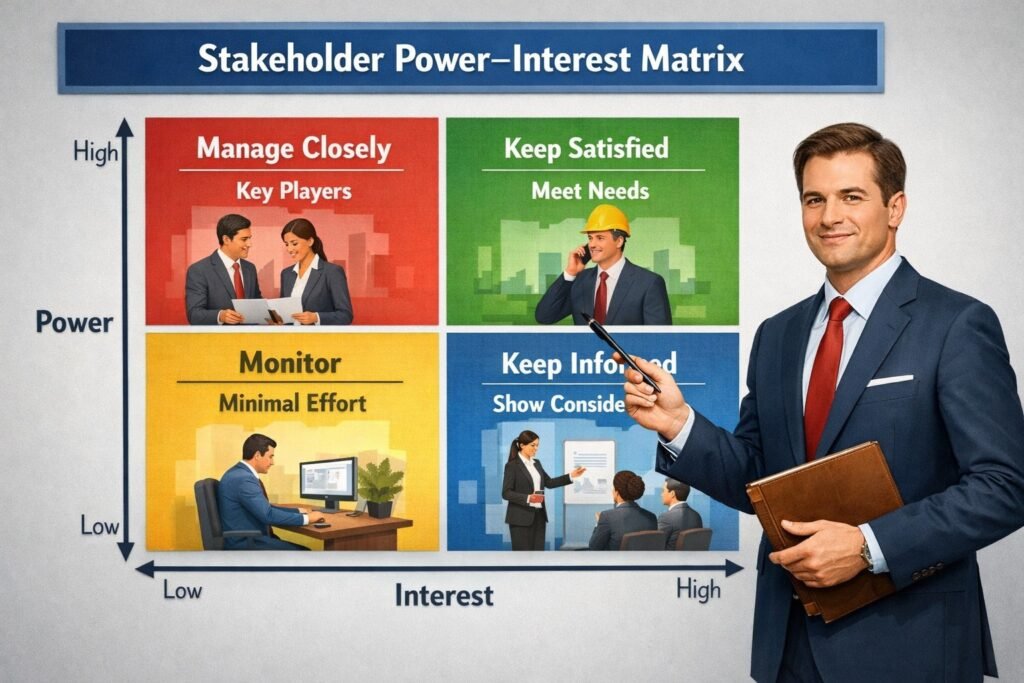
This template is designed to guide you through the creation and analysis of this matrix. It provides deep insight into the psychology of the four quadrants and offers actionable strategies for managing the relationships within each one. This document should be considered a confidential internal strategic tool. It is rarely wise to show a stakeholder that you have classified them as “Low Power,” as this can damage relationships. Use this tool with your core team and Sponsor to align your communication strategy.
Section 1: Defining the Axis of Power (The Y-Axis)
Guidance for Completion
The vertical axis of the grid represents Power. To plot stakeholders accurately, you must first agree on what “Power” means in the context of your specific organization. Power is not always reflected in a job title. A Senior VP might have high organizational rank but zero power over your specific IT migration project because they work in HR. Conversely, a junior database administrator might have immense power because they are the only person who knows the password to the legacy system.
Criteria for Assessing Power
When evaluating a stakeholder’s power, ask the following questions:
- Budget Authority: Can this person sign checks? Can they increase or decrease your budget?
- Resource Control: Can this person grant or withhold the staff you need? (e.g., a Functional Manager).
- Veto Power: Can this person stop the project immediately? (e.g., Compliance Officer, Security Architect).
- Decision Making: Is their vote required to pass a “Phase Gate”?
- Influence: Do they have the ear of the CEO? If they complain, will people listen?
The Scale
You should plot stakeholders on a scale from Low to High.
- High Power: They can unilaterally kill the project or ensure its success.
- Medium Power: They can cause significant friction or provide significant help, but they cannot kill the project alone.
- Low Power: They have no ability to change the project scope, budget, or timeline.
Draft Example for Context
“The Executive Assistant: often misclassified as Low Power. However, in this project, the CEO’s Executive Assistant controls the calendar. If we cannot get on the CEO’s calendar for sign-off, the project fails. Therefore, regarding ‘Schedule Power,’ this stakeholder is High.”
Section 2: Defining the Axis of Interest (The X-Axis)
Guidance for Completion
The horizontal axis represents Interest. This creates a distinction between those who are powerful but indifferent and those who are powerful and engaged. Interest refers to the level of concern, curiosity, or active involvement the stakeholder has in the project.
Criteria for Assessing Interest
When evaluating interest, ask these questions:
- Impact: Will this project change their daily job? (High impact usually drives High interest).
- Intellectual Curiosity: Do they just personally like this topic?
- Political Gain: Will being associated with this project help their career?
- Fear: Are they worried this project will eliminate their role? (Fear drives very high interest).
The Scale
- High Interest: They read every email. They attend every town hall. They have strong opinions on the requirements. They want to be involved in the details.
- Low Interest: They only care about the final result (ROI). They do not want to know how the sausage is made. They skip meetings.
Draft Example for Context
“The CFO: often assumed to be High Interest because they pay for it. However, if the project is small ($50k), the CFO might be Low Interest. They just want to know it is on budget. They do not care about the color of the buttons.”
Section 3: The Four Quadrants Overview
Guidance for Completion
Once you have defined your axes, the grid naturally forms four quadrants. You must understand the archetypes of each quadrant to manage them effectively.
The four quadrants are:
- High Power / High Interest (Manage Closely): The Key Players.
- High Power / Low Interest (Keep Satisfied): The Sleeping Giants.
- Low Power / High Interest (Keep Informed): The Defenders / The Noise.
- Low Power / Low Interest (Monitor): The Crowd.
In the following sections, we will explore the detailed management strategy for each quadrant. You should use these sections to document the specific stakeholders in your project who fall into these categories and outline your specific plan for them.
Section 4: Quadrant A Strategy (High Power / High Interest)
The “Manage Closely” Group
These are your most critical stakeholders. They are the “Promoters” or the “Game Changers.” They have the power to make decisions and the interest to actually show up and make them. This group typically includes the Project Sponsor, the Steering Committee, and the primary Business Owner.
The Strategy
Your strategy here is maximum engagement. You must treat them as partners.
- Communication: High frequency. Face-to-face (or video) is preferred over email. Do not just send them reports; talk them through the reports.
- Involvement: Involve them in decision-making early. Do not present them with a finished decision; present them with options and let them choose. This builds buy-in.
- Risk: The biggest risk here is misalignment. If they think you are building X and you are building Y, they have the power to fire you.
Draft Example: Management Plan
Stakeholders in this Quadrant: Project Sponsor (Sarah), VP of Sales (Mark).
Action Plan:
- Weekly: 30-minute sync with Sarah to review risks.
- Monthly: Steering Committee chaired by Sarah.
- Ad-hoc: Immediate escalation via phone (not email) if any “Red” status events occur.
- Tip: Never let this group be surprised. Bad news must be delivered personally and promptly.
Section 5: Quadrant B Strategy (High Power / Low Interest)
The “Keep Satisfied” Group
These are the “Latent” stakeholders. They are often senior executives (e.g., CFO, Legal Counsel, Compliance Director, CEO) who have immense power but many other priorities. They are not interested in the day-to-day of your project.
The Danger
This is the most dangerous quadrant. Because they are “Low Interest,” you might be tempted to ignore them. Do not do this. If something goes wrong (e.g., a budget overrun or a compliance breach), their interest will suddenly shift from Low to High, and they will use their High Power to crush the project.
The Strategy
Your strategy here is protection and brevity.
- Communication: Low frequency, high quality. Executive summaries only. Focus on the bottom line (Cost, Time, Risk).
- Engagement: Only engage them when necessary. Do not drag them into workshops. Consult them only on their specific area of domain (e.g., ask Legal about the contract, nothing else).
- Goal: Keep them “Satisfied” so they remain “Low Interest.” You want them to stay asleep.
Draft Example: Management Plan
Stakeholders in this Quadrant: CFO, Head of Legal.
Action Plan:
- Monthly: Send a “One-Pager” dashboard focusing on budget and regulatory status.
- Engagement: Schedule a 15-minute review only at key Phase Gates.
- Validation: Ensure the Head of Legal signs off on the final contract terms, but do not invite her to the vendor selection demos.
Section 6: Quadrant C Strategy (Low Power / High Interest)
The “Keep Informed” Group
These are often the “Defenders” or the “Workforce.” This group usually includes the end-users, subject matter experts (SMEs), and middle managers who will use the system you are building. They care passionately (High Interest) because it affects their daily lives, but they lack the authority (Low Power) to sign off on budget or scope.
The Nuance
These stakeholders can be your best allies or your worst nightmare.
- As Allies: They can identify risks that executives miss. They can be your “beta testers” and champions.
- As Blockers: If ignored, they can create “noise.” They can send complaint emails to their bosses (who are High Power), effectively turning public opinion against the project.
The Strategy
Your strategy here is information and empathy.
- Communication: High volume. Newsletters, town halls, FAQs, training sessions. They want details.
- Engagement: Listen to them. Even if you cannot implement every feature they want, showing that you have heard them reduces resistance.
- Leverage: Use this group to validate requirements.
Draft Example: Management Plan
Stakeholders in this Quadrant: Customer Service Agents, Warehouse Staff.
Action Plan:
- Bi-Weekly: “Project Spotlight” email newsletter detailing upcoming changes.
- Monthly: “Lunch and Learn” demo sessions where they can see the prototype.
- Feedback: Establish a dedicated email address for them to submit questions and concerns.
Section 7: Quadrant D Strategy (Low Power / Low Interest)
The “Monitor” Group
These are the “Apathetics” or the “Crowd.” This includes the wider organization, external vendors not involved in the project, or the general public. They have no power to change the project and do not care about it.
The Strategy
Your strategy here is minimal effort.
- Communication: Passive. Put information on the intranet. If they want to find it, they can. Do not clutter their inboxes.
- Monitoring: Check occasionally to see if their status changes. For example, if the press starts writing about your project, the “General Public” might shift to High Interest.
Draft Example: Management Plan
Stakeholders in this Quadrant: The HR Department (for a non-HR project), Facilities Management.
Action Plan:
- Method: Self-service intranet page.
- Action: None required unless a specific dependency is identified.
Section 8: Mapping the Stakeholders (The Workshop Guide)
Guidance for Completion
You should not complete this matrix alone at your desk. It is a subjective exercise, and your perception of power might be wrong. Ideally, this should be done in a workshop setting with your core project team.
Step-by-Step Workshop Instructions
- Preparation: Print out the names of all stakeholders from the Register onto sticky notes. Draw a large X/Y axis on a whiteboard.
- First Pass (Plotting): Ask the team to place the sticky notes on the grid. “Where does the Marketing Director go?”
- Debate: This is the valuable part. One team member might say, “She is Low Power,” while another says, “No, she is the CEO’s sister, she is High Power.” Discussing these discrepancies reveals hidden political risks.
- Clustering: Once everyone is on the board, draw circles around the quadrants.
- Refinement: Look at the “Manage Closely” quadrant. If you have 20 people in there, you have a problem. You cannot closely manage 20 people. You must ruthlessly reprioritize. Move some to “Keep Satisfied.” Aim for 5 to 10 key players in the top right.
The Sensitivity Warning
Crucial Rule: Do not leave this whiteboard drawing up in a shared meeting room. Do not digitize it and save it on a public SharePoint site. If a VP sees you have labeled them “Low Power,” it will create an unnecessary conflict. Translate the visual grid into a “Communication Plan” document (which is sanitized) for public consumption. Keep the raw Matrix confidential.
Section 9: Handling Stakeholder Movement (Dynamics)
Guidance for Completion
The Matrix is not static. Stakeholders move between quadrants throughout the project lifecycle. You must anticipate these shifts.
Common Shifts
- The “Go-Live” Shift: End-users (Quadrant C) often move to High Power (Quadrant A) during User Acceptance Testing (UAT). Suddenly, they have the power to say “System Rejected.” You must increase your management of them during this phase.
- The “Budget Crisis” Shift: The Finance Team (Quadrant B) might ignore you for months. But if you request more money, they instantly become High Interest/High Power.
- The “Promotion” Shift: A stakeholder gets promoted. They take their “High Interest” with them to a “High Power” role.
Review Cadence
Include a “Stakeholder Matrix Review” agenda item in your monthly internal team meeting. Ask: “Has anyone moved? Does anyone need a different strategy?”
Section 10: The Third Dimension (Attitude)
Guidance for Completion
While the standard matrix has two dimensions (Power and Interest), advanced project managers often add a third dimension: Attitude (or Support).
Color Coding
You can use color to represent this on your visual map:
- Green: Supporter (Pro-project).
- Red: Detractor (Anti-project).
- Yellow: Neutral.
Strategic Implications
This adds nuance to your strategy.
- High Power / High Interest / Red (The Antagonist): This is your biggest threat. You need a mitigation plan immediately. Can you convert them? Can you neutralize their concerns?
- High Power / High Interest / Green (The Champion): This is your greatest asset. Use them to influence the “Reds.”
Draft Example
“Analysis of the CIO:
- Power: High.
- Interest: High.
- Attitude: Red (Resistant).
- Reason: She prefers a different technology stack.
- Strategy: We cannot ignore her (she is High Power). We must engage her technical architects to prove our solution is viable, aiming to move her from Red to Yellow (Neutral).”
Section 11: Summary of Strategic Actions
Guidance for Completion
Use this section to create a quick reference table for your project team. It synthesizes the theory into instructions.
| Quadrant | Description | Goal | Communication Style | Frequency |
| A: Top Right | High Power / High Interest | Partner | Face-to-Face, Consultation, Decision-Oriented | Daily / Weekly |
| B: Top Left | High Power / Low Interest | Satisfy | Executive Summaries, Bottom-Line focus | Monthly / Ad-hoc |
| C: Bottom Right | Low Power / High Interest | Inform | Newsletters, Demos, FAQs, Empathy | Weekly / Bi-Weekly |
| D: Bottom Left | Low Power / Low Interest | Monitor | Passive Website / Intranet | Self-Service |
Conclusion
The Stakeholder Power–Interest Matrix is the bridge between data and strategy. While the Stakeholder Register provides the raw information, the Matrix provides the intelligence. It forces the project leadership to confront the reality of limited resources. You simply cannot make everyone happy, nor should you try.
By completing this template, you are making deliberate choices about where to invest your energy. You are choosing to focus on the “Promoters” who will drive the project forward and the “Latents” who could derail it. You are choosing to inform the “Defenders” without letting them bog down the decision-making process.
This document is a snapshot in time. As the project evolves, so too will the landscape of power and interest. A savvy Project Manager keeps this matrix mentally active at all times, constantly scanning the room to see who is gaining influence and who is losing interest.
Finally, remember that this tool is fundamentally about relationships. A dot on a grid is not a person. The grid helps you plan, but the execution requires emotional intelligence, active listening, and genuine human connection. Use this map to find your way, but use your interpersonal skills to make the journey successful.
Meta Description
A guide and template for the Stakeholder Power–Interest Matrix. Learn to map stakeholders by influence and concern to define effective communication strategies.
Discover More great insights at www.pmresourcehub.com