
Top 10 Consulting KPIs That Prove Project Value
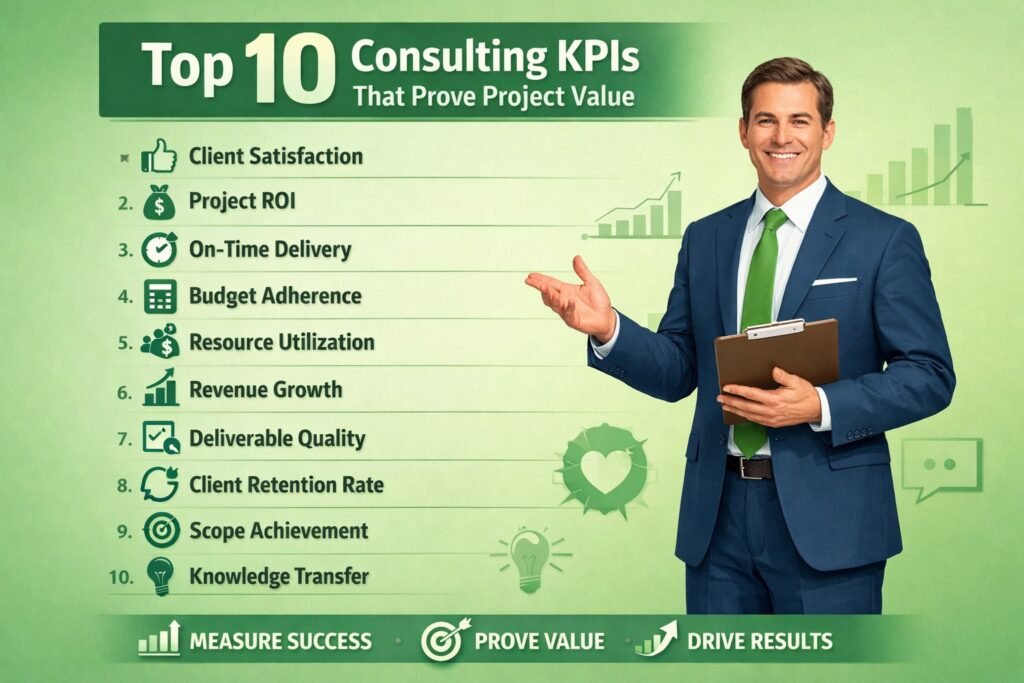
In today’s enterprise environment, consulting engagements are under increasing scrutiny. Executive stakeholders no longer accept qualitative assurances of success they demand quantifiable proof that consulting initiatives deliver measurable business value. As organisations invest heavily in transformation programmes, digital initiatives, and operational optimisation, the pressure on consultants to demonstrate tangible outcomes has never been greater.
This is where Key Performance Indicators (KPIs) become mission-critical. KPIs provide a structured, data-driven mechanism for evaluating consulting performance, aligning delivery with strategic objectives, and proving value at every stage of the engagement lifecycle.
Understanding and implementing the right KPIs is not simply a reporting exercise it is a strategic capability that separates high-performing consulting firms from the rest of the market. This article explores the top 10 consulting KPIs that prove project value, while also outlining how enterprises can operationalise them to drive sustained success.
Understanding the Importance of KPIs in Consulting Projects
KPIs have become the foundation of modern consulting governance. In complex enterprise environments, where multiple stakeholders, business units, and delivery streams intersect, success cannot be measured through anecdotal feedback alone. Instead, organisations require standardised, objective metrics that provide clarity, accountability, and transparency.
At their core, KPIs serve three critical functions.
First, they quantify value delivery. Consulting engagements often promise outcomes such as cost reduction, revenue growth, or operational efficiency. Without KPIs, these outcomes remain abstract. With KPIs, they become measurable and defensible.
Second, KPIs enable real-time performance management. Rather than waiting until project closure to assess success, organisations can monitor progress continuously, identifying risks, inefficiencies, and deviations early. This allows for proactive intervention, ensuring that projects remain aligned with objectives.
Third, KPIs strengthen stakeholder confidence and governance. When executives have access to consistent, data-driven insights, decision-making becomes more informed and less reliant on subjective interpretation. This is particularly important in board-level reporting, where clarity and precision are essential.
In large organisations, where consulting engagements often span multiple geographies and functions, KPIs act as a common language of performance, ensuring alignment across all levels of the enterprise.
Key Performance Indicators: What You Need to Know
Before selecting KPIs, it is essential to understand their structure and classification. Not all KPIs serve the same purpose, and effective measurement frameworks typically incorporate a balanced mix across different categories.
Input KPIs measure the resources invested into a project, such as budget, workforce, or technology. While important, they do not directly indicate success.
Output KPIs track deliverables produced, such as reports, systems, or process changes. These provide visibility into activity but still fall short of measuring true value.
Outcome KPIs focus on the results generated by those deliverables. Examples include cost savings, productivity improvements, or customer satisfaction increases. These are often the most critical indicators of consulting success.
Process KPIs evaluate the efficiency and effectiveness of delivery, such as cycle times or resource utilisation rates.
For enterprise consulting, the most effective KPI frameworks integrate all four categories, ensuring a holistic view of performance.
Additionally, KPIs must adhere to the SMART principle they must be Specific, Measurable, Achievable, Relevant, and Time-bound. This ensures that metrics are not only meaningful but also actionable.
How to Select the Right KPIs for Your Consulting Engagement
Selecting the right KPIs is a strategic exercise that requires alignment with both client objectives and organisational priorities.
The starting point is defining success at the executive level. What outcomes does the organisation expect? Are they focused on cost reduction, revenue growth, operational efficiency, or strategic transformation? KPIs must directly map to these priorities.
Next, organisations must assess data availability and integrity. Even the most sophisticated KPI framework will fail if the underlying data is inconsistent, fragmented, or unreliable. This is particularly relevant in large enterprises with legacy systems and siloed data structures.
Stakeholder engagement is also critical. KPIs should not be imposed in isolation they must be co-created with key stakeholders, including sponsors, delivery teams, and governance bodies. This ensures relevance, buy-in, and accountability.
Finally, organisations should avoid overcomplication. While it may be tempting to track dozens of metrics, high-performing consulting engagements typically focus on a core set of KPIs that provide maximum insight with minimal complexity.
Top 10 Consulting KPIs That Prove Project Value
To effectively demonstrate value, consulting firms must adopt a balanced set of KPIs that capture financial performance, client perception, operational efficiency, and strategic alignment.
1. Return on Investment (ROI)
ROI is the definitive metric for assessing consulting value. It measures the financial return generated relative to the cost of the engagement.
A strong ROI provides clear evidence that the consulting initiative has delivered tangible business benefits. For executive stakeholders, ROI is often the primary factor in determining whether to continue or expand engagements.
2. Net Promoter Score (NPS)
NPS evaluates client loyalty and advocacy. It goes beyond satisfaction to measure whether clients would actively recommend the consulting firm.
High NPS scores are indicative of strong relationships and long-term value delivery, making this KPI essential for firms seeking to build strategic partnerships.
3. Client Satisfaction Score (CSAT)
CSAT captures immediate feedback on service quality and delivery effectiveness. Typically measured at key milestones, it provides real-time insights into client perception.
This KPI is particularly valuable for identifying issues early and implementing corrective actions before they escalate.
4. Client Retention Rate
Retention rate measures the percentage of clients who continue to engage with the consulting firm over time.
In enterprise environments, high retention rates signal consistent value delivery and strong alignment with client needs. It also reflects the firm’s ability to transition from project-based work to long-term partnerships.
5. Cost Performance Index (CPI)
CPI assesses financial efficiency by comparing planned versus actual costs.
Maintaining a favourable CPI is critical in large-scale consulting programmes, where budget overruns can significantly impact overall value perception.
6. Project Cycle Time
Cycle time measures the duration required to complete a project or deliver specific outcomes.
Reducing cycle time enhances time-to-value, enabling organisations to realise benefits more quickly and respond to market changes with greater agility.
7. Resource Utilisation Rate
This KPI evaluates how effectively consulting resources are deployed.
Optimising utilisation ensures that resources are used efficiently while maintaining delivery quality. It also has a direct impact on profitability and operational performance.
8. Value Realisation Rate
Value realisation measures the extent to which expected benefits are achieved after implementation.
This KPI is critical for bridging the gap between delivery and outcomes, ensuring that projects generate sustained value beyond completion.
9. Number of Change Requests
Tracking change requests provides insight into scope stability and project governance.
A high volume of changes may indicate misalignment, unclear requirements, or ineffective stakeholder engagement. Managing this KPI is essential for maintaining control over timelines and budgets.
10. Strategic Alignment Score
This KPI evaluates how well the project supports broader organisational goals.
In enterprise consulting, delivering outputs is not enough those outputs must contribute to strategic objectives such as growth, innovation, or transformation.
Operationalising KPIs in Enterprise Consulting
Defining KPIs is only the first step. To unlock their full value, organisations must embed them into governance frameworks, reporting mechanisms, and decision-making processes.
This typically involves implementing centralised dashboards that provide real-time visibility into performance metrics. These dashboards enable executives to monitor progress, identify risks, and make informed decisions quickly.
Additionally, KPIs should be integrated into performance management systems, ensuring that both consultants and internal teams are accountable for delivering measurable outcomes.
Standardisation is also critical. By applying consistent KPI frameworks across engagements, organisations can benchmark performance, identify best practices, and drive continuous improvement.
How KPIs Drive Strategic Decision-Making
KPIs are not merely retrospective they are powerful tools for shaping future strategy.
By analysing KPI trends over time, organisations can identify patterns, uncover inefficiencies, and prioritise high-impact initiatives. For example, consistently low value realisation rates may indicate a need to improve post-implementation support or change management processes.
KPIs also enable scenario planning and forecasting, allowing organisations to model potential outcomes and make proactive decisions.
In this way, KPIs evolve from simple measurement tools into strategic enablers of enterprise transformation.
Real-World Examples of KPI-Driven Value
Consider a global consulting firm delivering a cost optimisation programme. By tracking ROI and CPI, the firm demonstrated a 250% return while maintaining strict budget control. This not only validated the project’s success but also secured additional engagements.
In another case, a digital transformation initiative leveraged NPS and CSAT to monitor stakeholder sentiment. Early identification of dissatisfaction allowed the team to adjust delivery approaches, ultimately improving client perception and ensuring project success.
A third example involves an operational efficiency programme that focused on cycle time and resource utilisation. By optimising these metrics, the organisation reduced delivery timelines by 20%, significantly accelerating value realisation.
These examples highlight how KPIs provide clear, quantifiable evidence of consulting impact, reinforcing their importance in enterprise environments.
From Measurement to Competitive Advantage
In a highly competitive consulting landscape, the ability to demonstrate value is a key differentiator.
Firms that effectively leverage KPIs can:
-
Build stronger client relationships through transparency
-
Enhance credibility with executive stakeholders
-
Improve delivery performance through data-driven insights
-
Differentiate themselves in a crowded market
Ultimately, KPIs transform consulting from a service-based model into a results-driven partnership.
Frequently Asked Questions (FAQ)
What are consulting KPIs and why are they important?
Consulting KPIs (Key Performance Indicators) are quantifiable metrics used to evaluate the effectiveness, efficiency, and value delivered by consulting engagements. In enterprise environments, they are essential because they provide objective, data-driven evidence of performance rather than relying on subjective assessments.
These KPIs help organisations answer critical questions such as:
-
Are we achieving the expected business outcomes?
-
Is the consulting engagement delivering measurable value?
-
Are resources being used efficiently?
Without consulting KPIs, organisations risk making decisions based on perception rather than performance. In contrast, a well-defined KPI framework enables transparent governance, improved accountability, and stronger stakeholder confidence, particularly at executive and board levels.
How do consulting KPIs differ from standard project KPIs?
While standard project KPIs focus primarily on delivery metrics such as time, cost, and scope, consulting KPIs go further by measuring business impact and value realisation.
Key differences include:
-
Project KPIs: Schedule adherence, budget variance, milestone completion
-
Consulting KPIs: ROI, value realisation, client satisfaction, strategic alignment
Consulting KPIs are more aligned with outcomes rather than outputs, meaning they evaluate whether the project actually delivered meaningful business benefits, not just whether it was completed successfully.
What is the most important KPI for proving project value?
The most critical KPI for proving project value is Return on Investment (ROI).
ROI directly measures the financial benefit generated compared to the cost of the consulting engagement. It is often the primary metric used by CFOs and executive stakeholders to assess whether a project was worthwhile.
However, relying solely on ROI can be limiting. A comprehensive view of project value should also include:
-
Client satisfaction (NPS, CSAT)
-
Operational improvements (cycle time, utilisation)
-
Strategic impact (alignment to business goals)
In enterprise consulting, value is multi-dimensional, so a balanced KPI set is always recommended.
How many KPIs should be used in a consulting project?
Best practice is to focus on 8–12 core KPIs.
Using too many KPIs can lead to data overload, confusion in reporting, and reduced focus on what truly matters.
High-performing organisations prioritise a concise, high-impact KPI set that provides clear insights across financial, operational, client, and strategic dimensions.
The goal is not to measure everything, but to measure what drives decision-making and proves value.
How do you select the right KPIs for a consulting engagement?
Selecting the right KPIs requires alignment with business objectives, stakeholder expectations, and available data.
A structured approach includes:
-
Define success criteria – What outcomes does the client expect?
-
Map KPIs to objectives – Ensure each KPI links to a strategic goal
-
Assess data availability – Confirm that metrics can be reliably measured
-
Engage stakeholders – Gain agreement and buy-in across leadership
The most effective KPIs are those that are relevant, measurable, and actionable, ensuring they drive meaningful insights rather than just reporting activity.
What is value realisation and why does it matter?
Value realisation refers to the extent to which the expected benefits of a project are actually achieved after implementation.
It is one of the most important KPIs in consulting because it bridges the gap between delivery and outcomes, ensures benefits are sustained over time, and validates the long-term impact of the engagement.
Many projects appear successful at delivery but fail to generate lasting value. Tracking value realisation ensures that consulting efforts translate into tangible business improvements, such as cost savings, revenue growth, or efficiency gains.
How can consulting KPIs improve client relationships?
Consulting KPIs play a critical role in building trust, transparency, and long-term partnerships.
By providing clear, data-driven insights, KPIs demonstrate accountability, set realistic expectations, and enable open and objective performance discussions.
Metrics such as NPS, CSAT, and retention rate also allow consultants to actively monitor client sentiment and respond proactively to concerns.
In enterprise environments, where relationships often span multiple projects and years, KPI transparency is a key factor in strengthening strategic partnerships.
What tools are used to track consulting KPIs?
Consulting KPIs are typically tracked using a combination of business intelligence tools (such as Power BI or Tableau), project management platforms, enterprise dashboards, and financial systems.
The most advanced organisations implement centralised KPI dashboards that provide real-time visibility across all projects and programmes.
These dashboards enable executives to monitor performance at a glance, identify risks early, and make faster, data-driven decisions.
How often should consulting KPIs be reviewed?
The frequency of KPI reviews depends on the nature of the project, but in enterprise consulting:
-
Operational KPIs (e.g., utilisation, cycle time): Weekly or bi-weekly
-
Financial KPIs (e.g., ROI, CPI): Monthly
-
Strategic KPIs (e.g., alignment, value realisation): Quarterly
Regular reviews ensure that issues are identified early and corrective actions can be taken before they impact overall project success.
Consistency is key, and KPIs should be embedded into governance routines and reporting cycles.
Can KPIs be used to predict project success?
Yes, when used effectively, KPIs can act as leading indicators of project success.
For example, declining CSAT scores may signal stakeholder dissatisfaction, increasing change requests may indicate scope misalignment, and low utilisation rates may highlight inefficiencies.
By analysing these trends, organisations can proactively address risks and improve outcomes. This predictive capability transforms KPIs from retrospective metrics into forward-looking decision tools.
What are the most common mistakes when using consulting KPIs?
Several common pitfalls can reduce the effectiveness of KPI frameworks:
-
Tracking too many metrics without clear purpose
-
Focusing only on outputs rather than outcomes
-
Using poor-quality or inconsistent data
-
Lack of stakeholder alignment on KPI definitions
-
Failing to act on insights generated
Avoiding these mistakes requires a disciplined approach to KPI design, governance, and continuous improvement.
How do consulting KPIs support enterprise-level decision making?
At the enterprise level, KPIs provide a single source of truth for performance evaluation.
They enable leaders to compare performance across projects and portfolios, prioritise investments based on measurable value, align initiatives with strategic objectives, and drive accountability across teams and functions.
In this context, KPIs are not just operational tools they are strategic enablers that inform high-level decision-making and long-term planning.
Are consulting KPIs relevant for all industries?
Yes, consulting KPIs are applicable across all industries, including financial services, healthcare, technology, manufacturing, and the public sector.
While the specific KPIs may vary depending on industry context, the core principle remains the same: measuring performance to prove and enhance value.
Customisation is key, and KPIs should always reflect the unique objectives, challenges, and regulatory requirements of the organisation.
Final Thought
Consulting KPIs are no longer optional they are a fundamental requirement for demonstrating value in modern enterprise environments. By understanding how to define, implement, and leverage these metrics, organisations can ensure that every consulting engagement delivers measurable, strategic impact.
Conclusion
In the modern enterprise, consulting success is no longer defined by deliverables alone. It is defined by the ability to demonstrate measurable, sustainable value.
By adopting and operationalising these top 10 consulting KPIs, organisations can create a robust framework for evaluating performance, driving continuous improvement, and aligning consulting efforts with strategic objectives.
For consulting firms, the message is clear: those who embrace KPI-driven delivery will not only enhance project outcomes but also position themselves as indispensable partners in their clients’ long-term success.
Tags: consulting KPIs, project value, enterprise consulting, ROI, client satisfaction, operational efficiency, KPI framework, business consulting, performance metrics, value realisation
Discover the 2026 KPI Handbook for Consulting Firms from Deltek
Hashtags:
#Consulting #KPIs #ProjectValue #EnterpriseTransformation #BusinessStrategy #ROI #ClientSuccess #OperationalExcellence #DataDriven #PMO #ValueManagement
https://pmresourcehub.com/library/project-go-no-go-decision-record-template-free-word-download/https://pmresourcehub.com/library/executive-approval-memo-template-free-word-download/
https://pmresourcehub.com/library/project-go-no-go-decision-record-template-free-word-download/https://pmresourcehub.com/library/executive-approval-memo-template-free-word-download/
https://pmresourcehub.com/library/project-go-no-go-decision-record-template-free-word-download/https://pmresourcehub.com/library/executive-approval-memo-template-free-word-download/