
Organizational Change Leadership in High-Stakes Programs
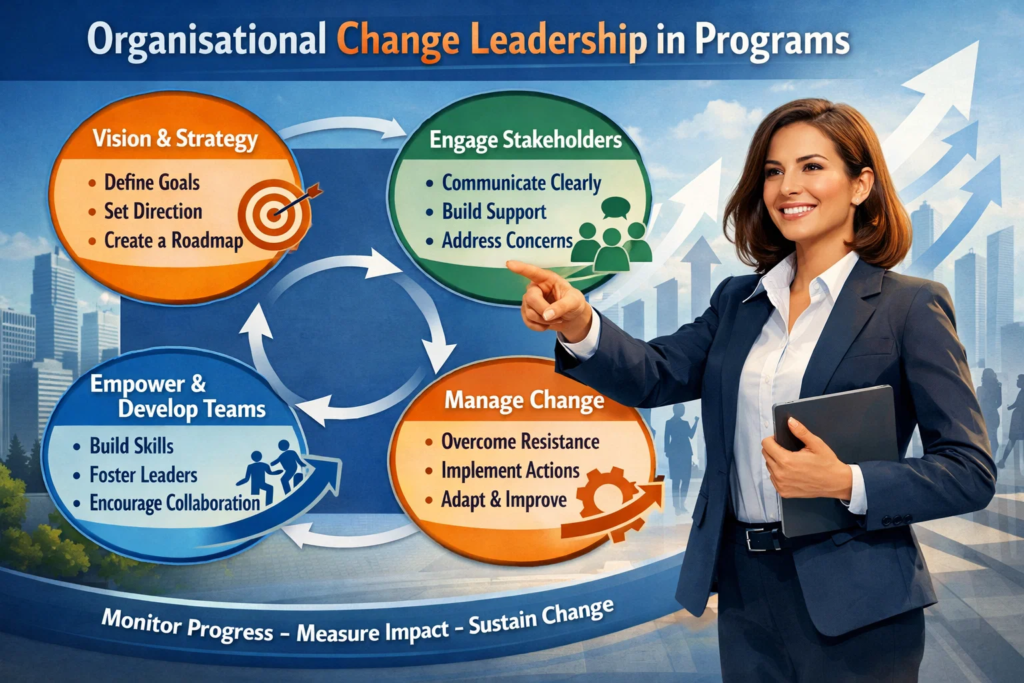
In today’s fast-paced and competitive business environment, organizations are frequently confronted with the necessity for transformative change, especially in high-stakes programs. The essence of successful change lies not just in the strategies implemented but in the leadership that steers these transformations. Effective change leadership can make the difference between success and failure, impacting not only the organization’s bottom line but also its culture and employee morale. This blog explores the nuances of organizational change leadership in high-stakes settings, delving into its importance, challenges, essential skills, strategies for stakeholder engagement, success measurement, case studies, resilience in change culture, and future trends.
Understanding the Importance of Change Leadership Today
In an era characterized by rapid technological advancements and shifting market dynamics, change leadership has emerged as a critical competency for organizations aiming to thrive in high-stakes programs. Unlike traditional management, which often focuses on stability and routine, change leadership embodies agility, vision, and the ability to navigate uncertainty. Leaders who prioritize change are able to inspire their teams, fostering a culture of innovation and responsiveness that is essential in a volatile business landscape.
Moreover, the effectiveness of change leadership extends beyond just operational improvements. A strong leader can influence organizational culture, ensuring that employees are engaged and motivated throughout the transformation process. When change is managed effectively, it not only leads to increased efficiency but also boosts morale, enhances collaboration, and cultivates a sense of ownership among employees. This collective commitment is vital for the sustainability of any high-stakes initiative.
Finally, the global nature of modern business requires a nuanced approach to change leadership. Leaders must recognize the diverse perspectives and cultural nuances present in their teams, adapting their styles to suit various contexts. By doing so, they not only drive better results but also build a more inclusive and resilient organization that is better equipped to face future challenges.
Key Challenges in High-Stakes Organizational Changes
Despite the critical importance of effective change leadership, organizations often encounter several significant challenges when implementing high-stakes changes. One primary hurdle is resistance from employees, who may feel anxious about new directions or skeptical about the potential benefits. This resistance can stem from a fear of the unknown or a lack of trust in leadership, making it essential for leaders to foster open communication and transparency throughout the process.
Another challenge is aligning stakeholders with the change vision. In large organizations, differing priorities and perspectives can lead to conflicts that hinder progress. Leaders must navigate these complexities, ensuring that all stakeholders are not only informed but also invested in the success of the initiative. This requires a careful balance of negotiation, persuasion, and active listening to address concerns and foster collaboration.
Additionally, high-stakes changes often involve substantial investments of time, resources, and capital. Leaders must be adept at risk management, identifying potential pitfalls and developing strategies to mitigate them. This can include creating contingency plans, continuously monitoring progress, and being open to course corrections as needed. Navigating these challenges requires resilience and a proactive mindset, ensuring that leaders are prepared to adapt as circumstances evolve.
Essential Skills for Effective Change Leaders
To effectively navigate the complexities of high-stakes change, leaders must possess a diverse set of skills that enable them to influence, engage, and inspire their teams. One key skill is emotional intelligence, which allows leaders to understand and manage their own emotions while empathizing with others. This capability is vital for addressing concerns and building trust among team members, particularly during periods of uncertainty or stress.
Another essential skill is strategic visioning. Effective change leaders must have the ability to articulate a clear and compelling vision for the future, aligning both the change initiative and the organization’s broader goals. This vision serves as a guiding star, helping employees understand the ‘why’ behind the change and motivating them to contribute to its success. A well-communicated vision also helps mitigate resistance by providing a framework for understanding the benefits of change.
Lastly, strong communication skills are crucial for change leaders. They must be able to convey complex information in a way that is accessible and relatable to various stakeholders. This involves not only delivering messages but also fostering open dialogue, encouraging feedback, and actively listening to concerns. By establishing a two-way communication channel, leaders can create a more inclusive environment that enhances engagement and commitment from their teams.
Strategies for Engaging Stakeholders During Change
Engaging stakeholders is a fundamental aspect of successful change management, particularly in high-stakes programs. One effective strategy for stakeholder engagement is to involve them early in the change process. By soliciting input and feedback at the initial stages, leaders can create a sense of ownership among stakeholders, increasing their commitment to the initiative. This participatory approach also helps identify potential challenges early, enabling proactive problem-solving.
Another strategy is to maintain regular communication throughout the change journey. This can involve updates via newsletters, meetings, or town halls, ensuring stakeholders are informed about progress, milestones, and any adjustments to the plan. By consistently communicating, leaders foster transparency and trust, which are essential for maintaining morale and engagement during times of uncertainty.
Finally, recognizing and celebrating small wins along the way can significantly enhance stakeholder buy-in. Highlighting achievements, no matter how minor, reinforces the positive aspects of change and demonstrates that progress is being made. This not only boosts team morale but also reminds stakeholders of the potential benefits of the initiative, keeping them motivated to support the ongoing transformation.
Measuring Success in High-Stakes Change Initiatives
Measuring the success of high-stakes change initiatives is crucial for organizations seeking to assess their impact and effectiveness. One common approach is to establish key performance indicators (KPIs) that align with the goals of the change initiative. These metrics can include financial outcomes, employee engagement scores, customer satisfaction levels, and operational efficiencies. By tracking these indicators, leaders can gain valuable insights into the effectiveness of their change efforts.
Additionally, conducting regular feedback sessions with employees and stakeholders can provide qualitative data on the perceived success of the initiative. These sessions allow teams to voice their experiences, challenges, and suggestions, offering leaders a deeper understanding of the change’s impact on the workforce. By integrating both quantitative and qualitative measures, organizations can create a comprehensive view of the initiative’s success and areas for improvement.
Finally, it is essential to celebrate successes and learn from failures. Conducting a post-implementation review enables organizations to assess what worked well and what did not, fostering a culture of continuous improvement. This reflective practice not only helps in future change initiatives but also reinforces the organization’s commitment to learning and adaptation, essential traits in high-stakes environments.
Case Studies: Change Leadership in Action
Examining real-world examples of change leadership in high-stakes programs provides valuable insights into effective practices and strategies. One notable case is that of a leading global technology firm that sought to undergo a significant digital transformation. By employing a change management framework that prioritized employee engagement, the leadership team conducted extensive workshops to involve employees in the process. This collaborative approach not only eased resistance but also generated innovative ideas that contributed to the successful implementation of new technologies.
Another compelling case is in the healthcare sector, where a large hospital network aimed to improve patient care through a system-wide change initiative. The leadership team focused on fostering a culture of collaboration by creating cross-functional teams to address challenges. This strategy not only facilitated the sharing of best practices but also empowered employees to take ownership of the change process. As a result, the hospital network saw marked improvements in patient satisfaction and operational efficiency.
Lastly, a prominent retail chain successfully navigated a major restructuring by prioritizing transparent communication and celebrating successes. The leadership team implemented regular town hall meetings to keep employees informed and engaged throughout the transition. By recognizing and rewarding employees’ contributions, they fostered a sense of community and commitment that ultimately led to a smooth transition and improved performance metrics in the following quarters.
Building a Resilient Change Management Culture
Creating a resilient change management culture is essential for organizations to thrive in a world of constant change. One foundational aspect of this culture is cultivating an environment that encourages experimentation and learning. Leaders should foster a mindset where employees feel safe to take risks, share new ideas, and learn from failures without fear of repercussions. This empowerment not only leads to innovative solutions but also strengthens the organization’s overall adaptability.
Another critical component is investing in continuous training and development. By equipping employees with the necessary skills and knowledge to navigate change, organizations can build a workforce that is both competent and confident. This can involve workshops, mentorship programs, and access to resources that enhance employees’ ability to embrace change proactively. A well-prepared workforce is more likely to respond positively to high-stakes changes, ensuring smoother transitions.
Additionally, organizations should prioritize feedback and adaptability as core values. Regularly soliciting input from employees and stakeholders allows leaders to gauge the effectiveness of change initiatives and make data-informed decisions. This feedback loop fosters a sense of ownership among employees and reinforces the idea that change is a collaborative effort. By embedding these practices into the organizational culture, leaders can create a resilient environment that not only copes with change but thrives on it.
Frequently Asked Questions (FAQ): Change Leadership in High-Stakes Programs
1. What is change leadership in high-stakes programs?
Change leadership in high-stakes programs refers to the strategic capability to guide organizations through complex, high-impact transformations where financial exposure, regulatory scrutiny, reputational risk, and operational continuity are all on the line. Unlike routine change management, high-stakes change leadership demands executive vision, decisive governance, rapid risk mitigation, and sustained stakeholder alignment. It is a mission-critical discipline that directly influences enterprise resilience and long-term performance.
2. Why is change leadership a competitive advantage in today’s business environment?
In a volatile, technology-driven economy, organizations face constant disruption—from digital transformation and regulatory shifts to mergers and market realignment. Strong change leadership enables enterprises to move faster than competitors, protect market share, accelerate innovation, and sustain operational stability. Companies that institutionalize high-performance change leadership outperform peers in agility, strategic execution, and long-term value creation.
3. How does change leadership differ from traditional change management?
Traditional change management focuses on process controls, communications plans, and transition tracking. Change leadership, by contrast, emphasizes strategic direction, executive influence, cultural transformation, and enterprise-wide alignment. While change management ensures structured implementation, change leadership inspires commitment, drives behavioral shifts, and sustains transformation momentum at scale.
4. What are the biggest risks in high-stakes transformation programs?
High-stakes programs carry amplified exposure across multiple dimensions, including:
-
Strategic misalignment
-
Executive sponsorship volatility
-
Regulatory non-compliance
-
Cultural resistance
-
Financial overruns
-
Operational disruption
-
Stakeholder disengagement
Without proactive change leadership, these risks compound quickly, undermining transformation objectives and eroding stakeholder trust.
5. What essential skills define an effective change leader?
Elite change leaders consistently demonstrate:
-
Strategic foresight and enterprise vision
-
Decisive decision-making under pressure
-
Executive communication excellence
-
Political intelligence and stakeholder influence
-
Emotional intelligence and cultural awareness
-
Risk anticipation and mitigation discipline
-
Data-driven performance oversight
These competencies allow leaders to maintain clarity and authority in uncertain environments.
6. How can leaders build organizational resilience during transformation?
Resilience is cultivated through transparent communication, psychological safety, capability upskilling, and strong governance frameworks. Leaders who reinforce adaptability, reward innovation, and embed continuous improvement practices create a durable change culture that sustains performance beyond the initial transformation wave.
7. Why is stakeholder engagement critical in high-stakes change programs?
Stakeholder alignment is often the single most decisive success factor. High-stakes programs involve executives, regulators, investors, frontline employees, and external partners. Structured stakeholder engagement—supported by influence mapping, targeted communications, and escalation pathways—reduces resistance, accelerates decision cycles, and protects transformation credibility.
8. How should organizations measure change leadership success?
Success metrics must extend beyond project completion milestones. High-impact indicators include:
-
Strategic objective achievement
-
Financial performance uplift
-
Employee engagement scores
-
Risk reduction metrics
-
Customer satisfaction improvement
-
Adoption rate of new systems or processes
-
Benefits realization against forecast
Measuring both tangible and cultural outcomes ensures transformation delivers sustainable enterprise value.
9. What cultural barriers commonly undermine transformation initiatives?
Cultural inertia, fear of job displacement, lack of trust in leadership, and unclear accountability structures frequently derail change efforts. Proactive leadership mitigates these barriers through early engagement, visible executive sponsorship, structured feedback loops, and transparent performance reporting.
10. What role does governance play in successful change leadership?
Strong governance frameworks provide the guardrails that enable agility without sacrificing control. Risk-tiered oversight, clear decision-right matrices, integrated reporting dashboards, and executive steering committees ensure transformation initiatives remain strategically aligned and compliant while progressing at speed.
11. How do high-performing organizations future-proof their change capability?
Forward-thinking enterprises institutionalize change leadership through leadership development programs, digital enablement tools, scenario planning capabilities, and AI-driven risk forecasting. By embedding transformation competency into organizational DNA, they maintain readiness for continuous disruption.
12. What is the future of change leadership in enterprise environments?
The future of change leadership will be defined by predictive analytics, real-time performance intelligence, ESG-integrated governance, and digitally enabled collaboration ecosystems. Leaders who combine strategic agility with disciplined execution will define the next generation of enterprise transformation excellence.
Future Trends in Organizational Change Leadership
As organizations continue to navigate an ever-evolving business landscape, several trends are emerging in the realm of change leadership. One significant trend is the increasing reliance on data analytics to inform decision-making. Leaders are leveraging data to understand employee sentiment, operational performance, and market trends, allowing them to make more informed choices regarding change initiatives. This shift towards data-driven leadership enhances the ability to predict potential challenges and seize opportunities.
Another notable trend is the rise of remote and hybrid work environments. As organizations adapt to this new normal, change leaders must develop strategies that consider the unique challenges of engaging remote teams. This may involve leveraging technology for communication, fostering virtual team-building activities, and ensuring that organizational values are effectively conveyed across digital platforms. Leaders who can successfully engage remote employees will be better positioned to drive successful change initiatives.
Finally, the emphasis on diversity, equity, and inclusion (DEI) is becoming increasingly prominent in change leadership. Organizations are recognizing the importance of diverse perspectives in driving innovation and improving decision-making. Leaders are prioritizing DEI initiatives, ensuring that change processes are inclusive and represent the voices of all stakeholders. By embracing diversity in their change efforts, organizations can create more innovative solutions and foster a sense of belonging among employees.
In conclusion, effective organizational change leadership in high-stakes programs is not merely a function of strategy but a blend of skills, culture, and stakeholder engagement. As organizations continue to face multifaceted challenges, leaders who embrace change as an opportunity for growth and empowerment will pave the way for sustainable success. By understanding the intricacies of change leadership and implementing best practices, organizations can not only navigate the complexities of high-stakes transformations but also thrive in an uncertain future
Hashtags: #ChangeLeadership #OrganizationalChange #HighStakes #StakeholderEngagement #FutureTrends
External Source: For more insights on change management, visit: https://www.prosci.com
Discover More great insights at https://www.pmresourcehub.com
Explore Free Project Management Templates https://pmresourcehub.com/library/