Project Lifecycle Phases: The Foundation for Predictable Delivery and ROI
What Is a Project Lifecycle?
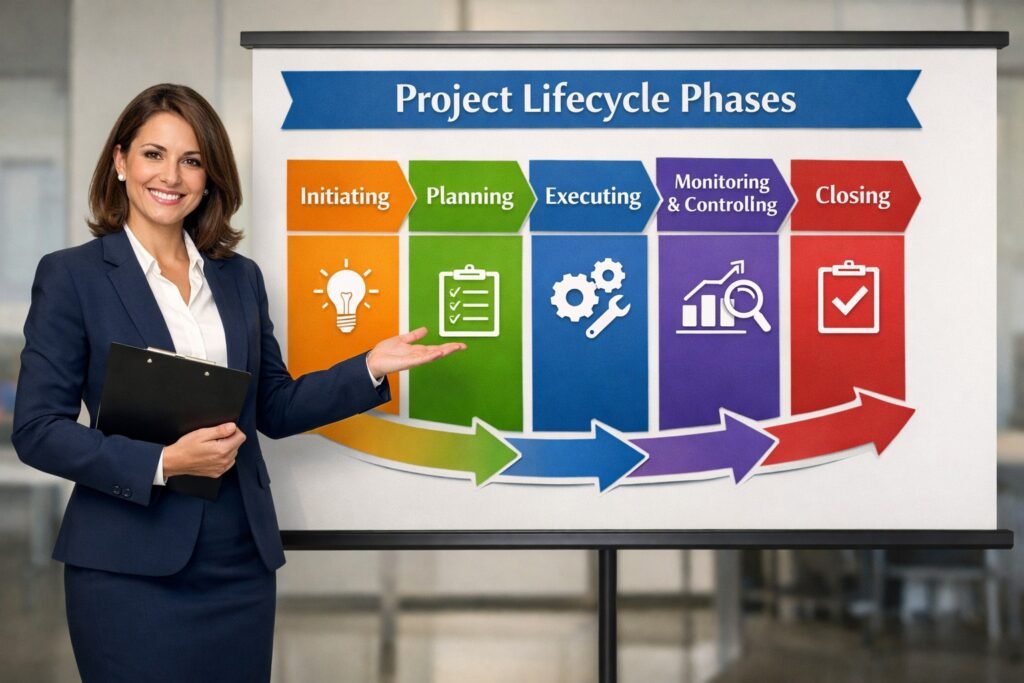
The Project Lifecycle Phases are the structured sequence that a project passes through from initial concept to formal closure. It provides a governance framework that defines what work is performed, when it is performed, who is accountable, and how progress and success are measured.
At an enterprise level, the project lifecycle is not merely a theoretical construct it is a control mechanism. It enables organizations to:
- Standardize delivery across portfolios and programs
- Establish decision gates for investment approval and continuation
- Align delivery activities with corporate strategy and compliance obligations
- Improve forecasting accuracy and capital allocation
In practical terms, the lifecycle acts as the backbone for planning, execution, monitoring, and closure. Without a clearly defined lifecycle, projects tend to drift, decisions become reactive, and performance data loses credibility.
[INTERNAL LINK: Project Lifecycle Overview Template]
Why the Project Lifecycle Directly Impacts ROI
Return on Investment (ROI) in projects is not created at the end it is designed in from the beginning. The project lifecycle plays a decisive role in this by enforcing discipline at critical points.
A well-defined lifecycle improves ROI by:
- Reducing rework through upfront clarity and staged validation
- Containing scope creep via formal change control mechanisms
- Improving predictability of cost and schedule performance
- Enabling early termination of underperforming initiatives
From a financial governance perspective, each lifecycle phase acts as a risk filter. Weak business cases are challenged early, technical assumptions are validated before scale, and delivery performance is continuously compared against baselines.
Organizations with mature lifecycle models consistently outperform peers in:
- Schedule adherence
- Cost variance control
- Benefits realization
- Stakeholder confidence
This is why most global frameworks Waterfall, Agile, PMP, and PRINCE2 are fundamentally lifecycle-driven, even if they differ in structure and philosophy.
The Waterfall Project Lifecycle
Overview of the Waterfall Approach
The Waterfall lifecycle is a linear, sequential model where each phase must be completed before the next begins. It assumes that requirements can be fully defined upfront and that change should be minimized once execution starts.
Despite frequent criticism, Waterfall remains dominant in:
- Construction and engineering
- Government and defense programs
- Regulated industries (finance, healthcare, utilities)
- Large-scale infrastructure and ERP implementations
Its strength lies in predictability, documentation, and control qualities highly valued in enterprise environments.
The Iron Triangle in Waterfall Projects
The Waterfall lifecycle is closely governed by the Iron Triangle, which defines the fundamental constraints of project delivery:
- Scope – What will be delivered
- Time – When it will be delivered
- Cost – How much it will cost
In Waterfall, scope is typically fixed early, which means time and cost are managed to accommodate that scope. Any change to one constraint has a direct impact on the others.
| Constraint | Waterfall Emphasis |
|---|---|
| Scope | Defined and baselined upfront |
| Time | Planned in detail before execution |
| Cost | Estimated and approved early |
This makes Waterfall highly suitable where contractual certainty and regulatory compliance outweigh flexibility.
[INTERNAL LINK: Iron Triangle Explained]
The Six Standard Phases of the Waterfall Lifecycle
1. Requirements Definition Phase
The Requirements Phase establishes a complete and unambiguous understanding of what the project must deliver.
Key activities include:
- Stakeholder identification and analysis
- Business requirements elicitation
- Functional and non-functional requirement documentation
- Assumption and constraint validation
- Formal requirements sign-off
Deliverables typically include:
- Business Requirements Document (BRD)
- Functional Specifications
- Non-functional requirements (performance, security, compliance)
This phase is critical because errors here propagate downstream, where they become exponentially more expensive to fix.
[INTERNAL LINK: Requirements Documentation Template]
2. System and Solution Design Phase
The Design Phase translates requirements into a technical and operational solution.
Activities include:
- High-level architecture design
- Detailed system design
- Data models and interface definitions
- Security and compliance design
- Design reviews and approvals
Deliverables may include:
- Solution Architecture Document
- Technical Design Specifications
- Process flow diagrams
The objective is to eliminate ambiguity before development begins. In Waterfall, design changes during implementation are strongly discouraged due to cost and schedule impacts.
3. Implementation (Build) Phase
The Implementation Phase is where the solution is constructed according to approved designs.
Key characteristics:
- Development follows detailed specifications
- Work is executed in logical sequence
- Progress is tracked against a fixed schedule
Typical activities include:
- Software development or physical construction
- Configuration and integration
- Unit-level quality checks
Project managers focus heavily on:
- Task sequencing and dependencies
- Resource utilization
- Schedule variance
This phase often consumes the majority of the project budget, making baseline accuracy essential.
[INTERNAL LINK: Work Breakdown Structure Template]
4. Verification and Testing Phase
The Testing Phase validates that the delivered solution meets defined requirements.
Common testing levels include:
- System testing
- Integration testing
- User Acceptance Testing (UAT)
- Compliance and regulatory testing
Testing in Waterfall is separate from build, which increases risk if defects are discovered late. However, it also provides a clear quality gate before deployment.
Deliverables include:
- Test plans and scripts
- Defect logs
- Formal acceptance documentation
5. Deployment and Implementation Phase
The Deployment Phase transitions the solution into the operational environment.
Activities include:
- Production rollout
- Data migration
- User training
- Operational handover
This phase is often tightly controlled due to operational risk, particularly in enterprise systems with high availability requirements.
[INTERNAL LINK: Deployment Checklist Template]
6. Closure and Benefits Realization Phase
The Closure Phase formally ends the project and confirms outcomes.
Key activities:
- Final deliverable acceptance
- Financial closure
- Lessons learned documentation
- Benefits tracking initiation
A mature organization does not stop at delivery it measures whether expected benefits are actually realized over time.
[INTERNAL LINK: Lessons Learned Register]
When Waterfall Works Best
Waterfall is most effective when:
- Requirements are stable and well-understood
- Regulatory documentation is mandatory
- Change costs are high
- Stakeholders demand predictability
Understanding its lifecycle phases provides a foundation for evaluating more adaptive models such as Agile which we will explore next.
The Agile Project Lifecycle: From Sequential Delivery to Continuous Value
Why Agile Emerged
The Agile project lifecycle emerged as a response to the limitations of traditional sequential delivery models most notably Waterfall. As software development accelerated and business environments became more volatile, organizations found that long planning horizons and rigid phase gates often resulted in solutions that were technically correct but strategically obsolete by the time they were delivered.
Agile represents a fundamental shift in how work is structured and governed. Instead of progressing through discrete, non-overlapping phases, Agile adopts an iterative and incremental lifecycle focused on rapid feedback, adaptive planning, and continuous value delivery.
At its core, Agile reframes the lifecycle question from:
“Have we completed the phase?”
to
“Have we delivered value, and what should we do next?”
This shift has profound implications for governance, risk management, and stakeholder engagement.
[INTERNAL LINK: Agile vs Waterfall Comparison]
Sequential vs Iterative Lifecycles
| Dimension | Waterfall | Agile |
|---|---|---|
| Structure | Linear, phase-based | Cyclical, iterative |
| Requirements | Fixed upfront | Evolving over time |
| Delivery | Single final release | Frequent incremental releases |
| Risk Exposure | High at late stages | Distributed across iterations |
| Feedback | Late | Continuous |
In Agile, planning, execution, testing, and review occur repeatedly in short cycles, dramatically reducing the risk of large-scale failure.
The Agile Manifesto and the 12 Principles (Brief Overview)
Agile is grounded in the Agile Manifesto, which prioritizes:
- Individuals and interactions over processes and tools
- Working solutions over comprehensive documentation
- Customer collaboration over contract negotiation
- Responding to change over following a plan
Supporting these values are 12 Agile Principles, which emphasize:
- Early and continuous delivery of valuable work
- Embracing changing requirements
- Frequent delivery in short timeframes
- Close collaboration between business and delivery teams
- Sustainable pace and technical excellence
Rather than enforcing strict phase gates, Agile embeds these principles directly into the lifecycle itself.
The Core Agile Lifecycle Loop
Unlike Waterfall, Agile does not prescribe a fixed number of phases. However, most Agile implementations follow a repeatable lifecycle loop that can be summarized as:
- Specify
- Build
- Test
- Release
- Review and Adapt
This loop is executed continuously until the product or project objectives are achieved.
1. Specify (Backlog Creation and Refinement)
The Specify phase defines what the team will work on next.
Key activities include:
- Creating and prioritizing the product backlog
- Writing user stories and acceptance criteria
- Estimating effort (story points or relative sizing)
- Sprint planning
Unlike Waterfall requirements, Agile specifications are:
- Lightweight
- Just-in-time
- Continuously refined
Ownership of this phase primarily sits with the Product Owner, who ensures alignment with business objectives and stakeholder expectations.
[INTERNAL LINK: Product Backlog Template]
2. Build (Sprint Execution)
The Build phase occurs within short, time-boxed iterations (sprints), typically lasting 1–4 weeks.
Activities include:
- Designing, developing, and integrating features
- Daily stand-ups to track progress and blockers
- Continuous collaboration across roles
In Agile, design and development are not separate lifecycle phases. They occur concurrently, enabling rapid validation and adjustment.
The team commits to a sprint goal rather than a fixed scope, reinforcing focus and accountability.
3. Test (Continuous Quality Validation)
Testing in Agile is continuous and embedded rather than deferred.
Key practices include:
- Automated unit and integration testing
- Continuous integration pipelines
- Peer reviews and quality checks
Quality is a shared responsibility, not a downstream activity. Features are not considered complete until they meet the team’s “Definition of Done.”
[INTERNAL LINK: Definition of Done Checklist]
4. Release (Incremental Deployment)
The Release phase delivers completed work into production or a usable environment.
Releases may occur:
- At the end of every sprint
- On a scheduled cadence
- On-demand when value is ready
This approach enables organizations to:
- Capture value earlier
- Validate assumptions with real users
- Reduce deployment risk
5. Review and Adapt (Inspect and Adapt)
Each iteration concludes with structured reflection.
Key ceremonies include:
- Sprint Review (stakeholder feedback)
- Sprint Retrospective (process improvement)
This phase institutionalizes learning and drives continuous improvement at both the product and team levels.
Agile Roles and Their Lifecycle Responsibilities
Product Owner
The Product Owner governs the lifecycle from a value perspective.
Responsibilities include:
- Defining and prioritizing backlog items
- Accepting completed work
- Aligning delivery with strategic goals
The Product Owner ensures that each lifecycle iteration maximizes ROI.
Scrum Master
The Scrum Master enables the lifecycle to function effectively.
Key responsibilities:
- Facilitating ceremonies
- Removing impediments
- Coaching the team in Agile practices
The Scrum Master does not manage scope or deadlines but ensures the lifecycle remains healthy and sustainable.
Development Team
The Development Team owns execution.
Characteristics:
- Cross-functional
- Self-organizing
- Accountable for delivery and quality
Lifecycle ownership is distributed, reinforcing transparency and shared accountability.
When the Agile Lifecycle Works Best
Agile is most effective when:
- Requirements are uncertain or evolving
- Speed-to-market is critical
- Stakeholder engagement is high
- Teams are empowered and mature
While Agile introduces flexibility, it does not eliminate structure it replaces rigid phases with disciplined iteration.
Global Project Management Standards: PMP (PMBOK® Guide) vs PRINCE2
While Waterfall and Agile describe how work flows, PMP (PMBOK® Guide) and PRINCE2 define how projects are governed. They are the two most widely adopted global standards in enterprise project management, yet they are frequently misunderstood or incorrectly compared.
The critical distinction is this:
- PMP / PMBOK® Guide is a framework built around process groups and knowledge areas
- PRINCE2 is a prescriptive methodology with defined processes, roles, principles, and management products
Both use lifecycle thinking, but they operationalize it very differently.
[INTERNAL LINK: PMP vs PRINCE2 Comparison Guide]
The PMP (PMBOK® Guide) Project Lifecycle
PMP Is a Framework, Not a Methodology
The PMBOK® Guide, published by PMI, does not prescribe how to run a project. Instead, it provides a flexible framework of best practices that can be tailored to any industry, size, or delivery approach.
At its core are five Process Groups that together form the project lifecycle:
- Initiating
- Planning
- Executing
- Monitoring and Controlling
- Closing
These process groups are not strictly linear. They overlap and interact throughout the project.
1. Initiating Process Group
The Initiating Process Group formally authorizes the project or phase.
Key objectives:
- Define high-level scope and objectives
- Identify stakeholders
- Secure executive sponsorship
Typical outputs include:
This phase establishes legitimacy and alignment before any significant investment is made.
[INTERNAL LINK: Project Charter Template]
2. Planning Process Group
The Planning Process Group is the most extensive and detailed.
It defines how the project will be executed, monitored, and controlled.
Planning covers all knowledge areas, including:
- Scope
- Schedule
- Cost
- Quality
- Resource
- Communications
- Risk
- Procurement
- Stakeholder Engagement
Key deliverables include:
- Project Management Plan
- Subsidiary management plans
- Baselines (scope, schedule, cost)
Unlike Waterfall, planning in PMP is iterative. Plans are refined as new information emerges.
[INTERNAL LINK: Project Management Plan Template]
3. Executing Process Group
The Executing Process Group performs the work defined in the plan.
Activities include:
- Coordinating people and resources
- Managing stakeholder engagement
- Implementing quality assurance
- Executing procurements
The project manager’s role is highly active here, balancing leadership, communication, and integration.
4. Monitoring and Controlling Process Group
This group runs in parallel with execution.
Its purpose is to:
- Track performance against baselines
- Identify variances
- Implement corrective or preventive actions
Key techniques include:
- Earned Value Management (EVM)
- Risk reassessment
- Change control
For example, cost performance is evaluated using:
[
CPI = \frac{EV}{AC}
]
Where:
- (EV) = Earned Value
- (AC) = Actual Cost
[INTERNAL LINK: Earned Value Management Guide]
5. Closing Process Group
The Closing Process Group formally ends the project or phase.
Activities include:
- Final deliverable acceptance
- Contract closure
- Lessons learned documentation
- Benefits transition
Closure ensures organizational learning and clean handover to operations.
Explore What is a life cycle from the APM https://www.apm.org.uk/resources/what-is-project-management/what-is-a-life-cycle/
The PRINCE2 Project Lifecycle
PRINCE2 as a Prescriptive Methodology
PRINCE2 (Projects IN Controlled Environments) is a process-driven methodology widely adopted in the UK, Europe, and public-sector environments.
It is built on:
- 7 Principles
- 7 Themes
- 7 Processes
The PRINCE2 lifecycle is explicitly defined through its 7 Processes, which dictate how a project moves from start to finish.
The 7 PRINCE2 Processes Explained
1. Starting Up a Project (SU)
Purpose: Ensure the project is viable and worthwhile before committing resources.
Key outputs:
- Project Brief
- Outline Business Case
This process is lightweight and focused on validation.
2. Directing a Project (DP)
This process runs throughout the lifecycle and is owned by the Project Board.
Responsibilities include:
- Authorizing stages
- Approving exceptions
- Providing strategic direction
This is a critical governance distinction from PMP, where authority is more centralized in the project manager role.
3. Initiating a Project (IP)
The Initiation Stage establishes a strong foundation.
Key deliverables include:
- Project Initiation Documentation (PID)
- Detailed Business Case
- Risk, Quality, and Communication strategies
[INTERNAL LINK: PRINCE2 PID Template]
4. Controlling a Stage (CS)
This process governs day-to-day management within each stage.
Activities include:
- Monitoring progress
- Managing issues and risks
- Reporting to the Project Board
Each stage operates as a mini lifecycle.
5. Managing Product Delivery (MP)
This process focuses on product-based planning.
The project manager coordinates with team managers to ensure:
- Work packages are delivered as agreed
- Quality criteria are met
6. Managing a Stage Boundary (SB)
At the end of each stage, the project is reassessed.
Activities include:
- Updating the Business Case
- Planning the next stage
- Requesting authorization to proceed
This reinforces PRINCE2’s principle of continued business justification.
7. Closing a Project (CP)
The project is formally closed once objectives are met or the Business Case is no longer viable.
Deliverables include:
- End Project Report
- Lessons Learned Report
PMP vs PRINCE2: Lifecycle Comparison
| Aspect | PMP (PMBOK®) | PRINCE2 |
|---|---|---|
| Nature | Framework | Methodology |
| Lifecycle Model | 5 Process Groups | 7 Processes |
| Flexibility | High | Moderate |
| Governance | PM-centric | Board-driven |
| Documentation | Tailored | Prescribed |
How Project Managers Navigate These Lifecycles
- PMP-certified PMs tailor process groups to suit Agile, Waterfall, or Hybrid environments
- PRINCE2 PMs operate within defined stages and escalation tolerances
In enterprise environments, many organizations blend both using PMP knowledge areas with PRINCE2 governance structures.
.
Hybrid Lifecycles, Critical Chain, and Lifecycle Selection Criteria
As organizations mature, they often discover that no single lifecycle model works universally. Complex initiatives demand flexibility in execution while retaining predictability in governance. This reality has driven the widespread adoption of Hybrid lifecycles and the renewed interest in advanced scheduling techniques such as the Critical Chain Method (CCM).
This section addresses how these approaches work, when to use them, and most importantly how to select the right lifecycle for your specific context.
[INTERNAL LINK: Hybrid Project Management Guide]
Hybrid Project Lifecycles
What Is a Hybrid Lifecycle?
A Hybrid lifecycle combines elements of predictive (Waterfall) and adaptive (Agile) delivery within a single project or program. The most common pattern is:
Predictive planning + Adaptive execution
This model recognizes that while governance, funding, and compliance often require upfront structure, solution development benefits from iterative delivery.
Common Hybrid Patterns
Waterfall Planning with Agile Execution
This is the most widely adopted Hybrid model in enterprise environments.
Structure:
- Upfront phases (Waterfall):
- Business case
- High-level requirements
- Architecture and funding approval
- Delivery phases (Agile):
- Iterative development
- Incremental releases
- Continuous stakeholder feedback
This approach is frequently used in:
- Digital transformation programs
- ERP modernization
- Regulated industries adopting Agile
[INTERNAL LINK: Hybrid Delivery Framework Template]
Parallel Lifecycles (Dual-Track Agile)
In this model, discovery and delivery run in parallel.
- One track focuses on:
- User research
- Validation
- Prototyping
- The other focuses on:
- Development
- Testing
- Deployment
This reduces rework while maintaining delivery momentum.
Governance in Hybrid Environments
Hybrid models introduce governance complexity. Successful organizations:
- Maintain stage gates for funding and risk approval
- Use Agile metrics (velocity, burn-down) within execution stages
- Map Agile outputs to enterprise reporting structures
The project manager’s role evolves into a delivery orchestrator, balancing adaptability with compliance.
The Critical Chain Method (CCM)
What Is Critical Chain Project Management?
The Critical Chain Method is an advanced scheduling approach derived from the Theory of Constraints. Unlike Critical Path Method (CPM), CCM focuses on resource constraints, not just task dependencies.
Key principles:
- Projects are delayed primarily by resource contention
- Safety buffers should be aggregated, not embedded in each task
- Focus should be on flow efficiency, not individual task optimization
[INTERNAL LINK: Critical Path vs Critical Chain]
Critical Chain vs Critical Path
| Dimension | Critical Path | Critical Chain |
|---|---|---|
| Focus | Task dependencies | Resource constraints |
| Buffers | Task-level | Aggregated project buffers |
| Behavior | Encourages multitasking | Discourages multitasking |
| Control | Schedule-centric | Flow-centric |
In CCM, safety time is removed from individual tasks and placed into:
- Project Buffers
- Feeding Buffers
This improves visibility and reduces Parkinson’s Law and Student Syndrome.
When Critical Chain Is Effective
CCM works best when:
- Resources are shared across multiple projects
- Schedule overruns are chronic
- Work is knowledge-based rather than repetitive
It is often layered onto Waterfall or Hybrid lifecycles rather than used independently.
How to Choose the Right Project Lifecycle
Key Selection Criteria
Choosing the right lifecycle is a strategic decision, not a technical one. It should be based on objective factors rather than organizational habit.
Key criteria include:
- Requirements stability
- Regulatory constraints
- Delivery risk
- Stakeholder availability
- Team maturity
Lifecycle Selection by Project Complexity
| Complexity Level | Recommended Lifecycle |
|---|---|
| Low | Waterfall |
| Medium | Hybrid |
| High | Agile / Hybrid |
Complexity increases with uncertainty, integration points, and stakeholder diversity.
Lifecycle Selection by Industry
| Industry | Common Lifecycle |
|---|---|
| Construction | Waterfall |
| Government | PRINCE2 / Waterfall |
| Financial Services | Hybrid |
| Software & Digital | Agile / Hybrid |
| Healthcare | Hybrid |
Lifecycle Selection by Team Size and Maturity
| Team Characteristic | Best Fit |
|---|---|
| Small, experienced | Agile |
| Large, distributed | Hybrid |
| Low Agile maturity | Waterfall / Hybrid |
| High compliance | PRINCE2 / Hybrid |
Comprehensive Lifecycle Comparison Table
| Criteria | Waterfall | Agile | PMP | PRINCE2 | Hybrid |
|---|---|---|---|---|---|
| Flexibility | Low | High | Medium | Medium | High |
| Governance | High | Low | High | Very High | High |
| Documentation | Extensive | Minimal | Tailored | Prescriptive | Balanced |
| Change Tolerance | Low | High | Medium | Low | High |
| Enterprise Fit | High | Medium | Very High | Very High | Very High |
Strategic Guidance for Enterprise Leaders
No lifecycle is inherently superior. The most successful organizations:
- Standardize governance frameworks
- Allow delivery flexibility within defined boundaries
- Train project managers to operate across models
Lifecycle fluency is now a core leadership competency.
Tools, Templates, and Execution Excellence Across the Project Lifecycle
Successfully managing project lifecycles requires more than methodology knowledge it requires the right tools, standardized templates, and disciplined execution habits. High-performing organizations treat tools and templates as enablers of governance, transparency, and scalability rather than administrative overhead.
This final section focuses on the most commonly used lifecycle management tools, practical phase-based checklists, and concludes with a call to action for PM Resource Hub.
[INTERNAL LINK: Project Management Tools Comparison]
Core Tools for Managing Project Lifecycles
Jira (Agile and Hybrid Environments)
Jira is the dominant tool for Agile and Hybrid delivery, particularly in software and digital programs.
Best suited for:
- Sprint planning and backlog management
- Iteration tracking and velocity measurement
- Agile reporting (burn-downs, cumulative flow)
Strengths:
- Strong integration ecosystem
- Highly configurable workflows
- Real-time visibility
Limitations:
- Requires governance overlays for enterprise reporting
- Less effective for predictive scheduling
[INTERNAL LINK: Jira Setup Guide for Projects]
Microsoft Project (Predictive and Hybrid Scheduling)
Microsoft Project remains the enterprise standard for predictive planning.
Best suited for:
- Waterfall schedules
- Critical Path and Critical Chain analysis
- Resource leveling
Strengths:
- Advanced scheduling logic
- Enterprise reporting compatibility
- Strong baseline control
Limitations:
- Steep learning curve
- Less intuitive for Agile teams
[INTERNAL LINK: MS Project Schedule Template]
Monday.com (Cross-Functional Visibility)
Monday.com bridges the gap between structure and usability.
Best suited for:
- Hybrid teams
- Portfolio-level visibility
- Stakeholder-friendly dashboards
Strengths:
- High usability
- Strong visual reporting
- Rapid adoption across functions
Limitations:
- Limited advanced scheduling
- Less rigorous governance controls
Lifecycle Phase Checklists for Success
Initiation Phase Checklist
- Clear business case approved
- Executive sponsor assigned
- Stakeholders identified
- Success metrics defined
[INTERNAL LINK: Business Case Template]
Planning Phase Checklist
- Scope baseline approved
- Schedule and cost baselines established
- Risk register completed
- Communication plan agreed
[INTERNAL LINK: Risk Register Template]
Execution Phase Checklist
- Team roles clearly defined
- Progress tracked against baselines
- Quality assurance embedded
- Stakeholder communication ongoing
Monitoring and Control Checklist
- Performance metrics reviewed regularly
- Variances analyzed and addressed
- Change control enforced
- Risks actively managed
Closure Phase Checklist
- Deliverables formally accepted
- Contracts closed
- Lessons learned documented
- Benefits realization ownership transferred
[INTERNAL LINK: Project Closure Checklist]
Common Lifecycle Failure Points (and How to Avoid Them)
High failure rates are rarely caused by the wrong methodology they are caused by poor lifecycle discipline.
Common issues include:
- Weak initiation and unclear value justification
- Overplanning without execution flexibility
- Inadequate stakeholder engagement
- Treating closure as administrative rather than strategic
Organizations that institutionalize lifecycle best practices consistently outperform peers.
Conclusion: Lifecycle Mastery as a Strategic Advantage
The project lifecycle is not merely a rigid sequence of steps it is a strategic operating model that forms the foundation for delivering consistent value across any organization. Mastery of project lifecycles allows leaders to transform abstract strategies into tangible outcomes by aligning work execution with business objectives, regulatory requirements, and stakeholder expectations. Whether you are leveraging Waterfall, Agile, PMP, PRINCE2, or Hybrid approaches, understanding the lifecycle deeply enables organizations to anticipate challenges, allocate resources effectively, and make informed decisions at every stage of a project.
By applying lifecycle principles deliberately, organizations achieve:
- Predictable delivery – With clearly defined stages and governance, teams can forecast timelines, mitigate risks proactively, and avoid costly last-minute changes. Predictability builds confidence with stakeholders and strengthens executive sponsorship.
- Improved ROI – Lifecycle discipline ensures that investments are tied to measurable outcomes. By embedding value validation at multiple points, organizations can minimize wasted effort, prioritize high-impact initiatives, and accelerate benefits realization.
- Stronger governance – Lifecycle mastery provides a structured framework for oversight, from approval gates to compliance checkpoints, ensuring alignment with organizational policies, standards, and risk management requirements.
- Scalable execution – When lifecycles are well-understood and consistently applied, organizations can replicate successful delivery models across multiple projects or programs, enabling portfolio-level efficiency and operational scalability.
The most effective project leaders do not demonstrate blind loyalty to a single methodology. Instead, they are lifecycle-literate, able to select, tailor, and integrate approaches based on project context, complexity, team capability, and organizational culture. They recognize that the choice of lifecycle is not an either/or decision; it is about flexibly combining methodologies, governance rigor, and delivery practices to maximize value while minimizing risk.
Furthermore, lifecycle mastery extends beyond process adherence it fosters a culture of continuous learning and improvement. Leaders who understand the nuances of each phase, the dependencies between tasks, and the feedback mechanisms embedded in Agile, Hybrid, or structured frameworks can anticipate bottlenecks, adjust strategies dynamically, and lead teams with authority and clarity.
In today’s fast-paced, high-stakes business environment, such proficiency is no longer optional it is a critical differentiator that separates high-performing organizations from those that struggle with unpredictability and inefficiency.
In short, lifecycle mastery transforms project management from a reactive activity into a strategic capability, enabling organizations to deliver value reliably, govern effectively, and scale confidently across complex portfolios.
Take the Next Step with PM Resource Hub
At PM Resource Hub, we provide professionally designed, enterprise-ready templates that align with every major project lifecycle and methodology.
Explore our library to access:
- Initiation and planning templates
- Agile and Hybrid delivery tools
- Governance and reporting artefacts
- Closure and benefits realization frameworks
Discover More great insights at www.pmresourcehub.com
Explore Free Project Management Templates https://pmresourcehub.com/library/
By standardizing your lifecycle execution with proven templates, you reduce risk, increase efficiency, and accelerate value delivery.