The Strategic Intersection
In the modern enterprise, projects are no longer isolated initiatives they are strategic levers that collectively determine organizational performance. The Project Management Office (PMO) sits at the nexus of execution, governance, and enterprise strategy, serving as the Risk Sentinel that ensures uncertainties are identified, measured, and managed consistently across all levels of the organization. By standardizing PMO Risk Management and Strategy practices and embedding a risk-aware culture, the PMO elevates risk from a tactical concern into a strategic asset.
The PMO’s Role in Risk Governance
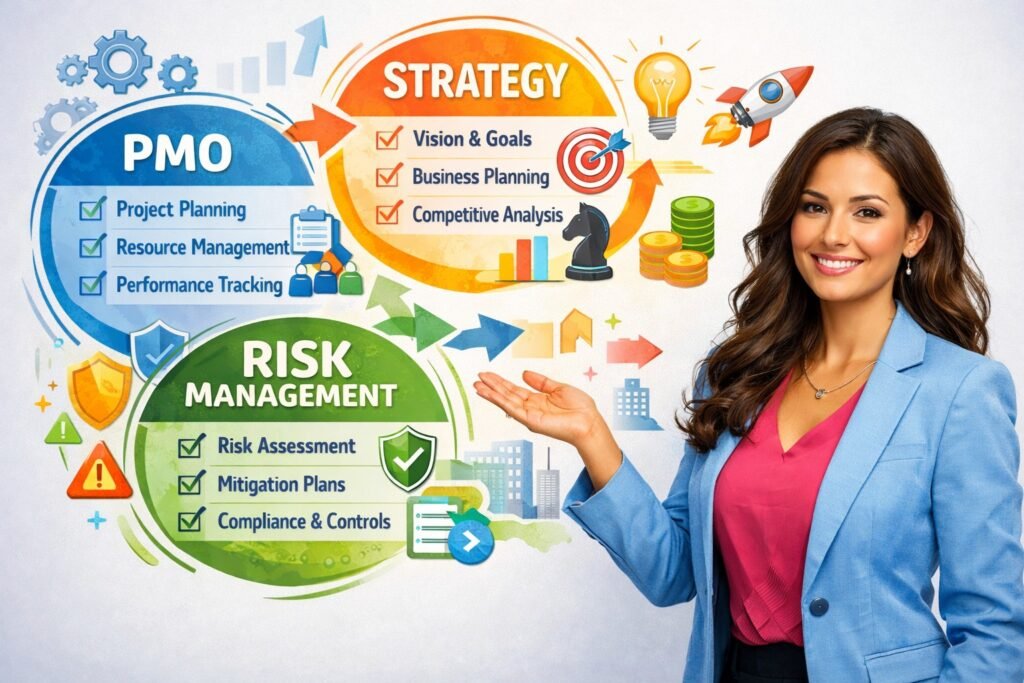
The PMO’s governance function is not limited to process oversight; it is a proactive mechanism for safeguarding enterprise value. Acting as the Risk Sentinel, the PMO provides a structured framework for identifying and mitigating potential threats while capitalizing on opportunities. This function encompasses both project-level risk those uncertainties specific to an individual initiative and portfolio-level risk, which represents interdependencies, resource constraints, and strategic exposure across multiple initiatives.
Project-Level Risk vs. Portfolio-Level Risk
Project-level risks are tactical in nature. They typically arise from scope changes, resource availability, technical complexity, or stakeholder dynamics. For example, a software deployment might encounter risks from integration issues or delayed testing cycles. The PMO ensures that project managers document, monitor, and escalate these risks consistently using standardized templates and dashboards.
Portfolio-level risks, by contrast, are strategic. They capture the ripple effects across multiple projects and the enterprise as a whole. Consider a scenario where a critical IT infrastructure project is delayed this can impact dependent projects, compliance deadlines, and ultimately, organizational strategy. The PMO aggregates these risks, evaluates correlations, and ensures executive stakeholders understand the cumulative exposure, prioritizing mitigation efforts that maximize organizational resilience.
Establishing a Risk Culture
A PMO’s ability to embed a risk-aware culture is a differentiator between ad hoc risk management and enterprise-grade governance. Establishing this culture begins with risk appetite, which defines the level of uncertainty an organization is willing to accept in pursuit of its objectives. The PMO standardizes risk appetite statements across business units, ensuring all teams operate under a consistent framework.
Key practices for cultivating a risk culture include:
- Training and Mentorship: PMO-led workshops, risk simulations, and mentorship programs for project managers and business leaders.
- Consistent Methodologies: Standardized processes for risk identification, assessment, response planning, and monitoring.
- Transparent Communication: Open reporting channels that encourage proactive escalation rather than reactive problem-solving.
- Incentives for Risk Awareness: Recognizing teams that identify and manage risks effectively fosters behavioral change and reinforces cultural norms.
By embedding these principles, the PMO transforms risk from an administrative task into a strategic capability, ensuring that uncertainty is not feared but managed as a source of potential advantage.
Standardizing Risk Management Practices
Consistency is the cornerstone of enterprise risk governance. The PMO enforces uniform risk taxonomies, scoring models, and escalation protocols across all projects. This standardization enables comparative analysis, portfolio-level aggregation, and strategic decision-making. For example, using a standardized probability-impact matrix allows the PMO to calculate Expected Monetary Value (EMV) across projects consistently.
Strategic Integration and Board-Level Oversight
The PMO serves as the bridge between project execution and corporate strategy. By synthesizing risk data across initiatives, the PMO provides the Board of Directors and C-suite with a holistic view of enterprise exposure. This integration ensures that strategic decisions, investment priorities, and resource allocations are informed by comprehensive risk intelligence.
A mature PMO does not simply report risks it contextualizes them, highlighting trends, interdependencies, and emerging threats. This positions the PMO not merely as a compliance function but as a strategic advisor capable of influencing corporate strategy and safeguarding enterprise value.
Key Takeaways for Section 1:
- The PMO functions as the Risk Sentinel, standardizing and governing risk across projects and portfolios.
- Distinguish project-level risks (tactical, isolated) from portfolio-level risks (strategic, correlated).
- Embed a risk culture through standardized practices, training, and incentives.
- Use quantitative frameworks like EMV for decision-making and executive reporting.
- Integrate risk insights with enterprise strategy to influence board-level decisions and optimize organizational outcomes.
The 5-Step Risk Management Process
Effective enterprise risk management is not an ad hoc exercise it is a disciplined, repeatable process that the PMO enforces across projects and portfolios. By standardizing the 5-Step Risk Management Process, the PMO ensures risks are not only identified but quantified, mitigated, and monitored in a way that aligns with strategic objectives.
Step 1: Risk Identification
The first step in any robust risk management framework is identification. The PMO leverages both structured and exploratory techniques to ensure no risk remains hidden:
- SWOT Analysis (Strengths, Weaknesses, Opportunities, Threats): Applied at both project and portfolio levels to uncover internal vulnerabilities and external threats.
- Delphi Technique: Engaging subject matter experts in iterative surveys to build consensus on potential risks.
- Risk Checklists and Historical Data: Utilizing previous project learnings, industry benchmarks, and regulatory requirements.
A PMO ensures that identification is not left solely to project managers, transforming it into a governance-wide exercise that captures risks across all organizational layers. Each risk is recorded in a standardized repository for analysis and tracking: [LINK: Risk Register Template].
Step 2: Qualitative Risk Analysis
Once identified, risks undergo qualitative analysis to prioritize attention. The PMO standardizes evaluation criteria using a probability-impact matrix:
| Probability | Impact | Risk Rating |
|---|---|---|
| High | High | Critical |
| Medium | High | Major |
| Low | Medium | Moderate |
| Low | Low | Minor |
Qualitative analysis helps the PMO distinguish between threats that could derail strategic objectives and minor tactical issues. Beyond scoring, the PMO evaluates interdependencies, ensuring that seemingly minor project risks do not cascade into significant portfolio exposure.
Step 3: Quantitative Risk Analysis
For risks with significant financial or operational implications, the PMO enforces quantitative analysis. Here, mathematical rigor informs executive decision-making. A common measure is Expected Monetary Value (EMV).
The PMO extends this approach to portfolio-level aggregation, enabling executives to understand cumulative risk exposure. Advanced techniques may include Monte Carlo simulations to model multiple scenarios, sensitivity analysis to identify critical risk drivers, and correlation analysis to assess inter-project dependencies.
By embedding quantitative metrics, the PMO moves risk discussions from anecdotal to data-driven, providing the Board with clear, actionable intelligence.
Step 4: Risk Response Planning
Not all risks require the same level of intervention. The PMO distinguishes between threats (negative impact) and opportunities (positive impact), defining a tailored response strategy:
- Threat Responses: Avoid, Mitigate, Transfer, or Accept
- Opportunity Responses: Exploit, Enhance, Share, or Accept
For example, a delayed supplier shipment (threat) may be mitigated by building alternative sourcing channels, while a favorable regulatory change (opportunity) may be exploited through accelerated market entry. The PMO ensures response planning is actionable, documented, and integrated into project and portfolio governance processes.
Step 5: Risk Monitoring and Control
The final step is continuous monitoring, where the PMO ensures that risk management is not a one-off activity but a persistent organizational capability. Key practices include:
- Regular Risk Reviews: PMs provide updates at project-level, while the PMO aggregates portfolio-level insights for executive reporting.
- Key Risk Indicators (KRIs): Quantifiable metrics that signal emerging threats or opportunities.
- Escalation Protocols: Defined thresholds for when risks must be escalated from project to portfolio to board-level attention.
- Audit and Assurance: PMO-led reviews validate that risk management processes are followed and remain effective.
Preventing “Check-the-Box” Risk Management
A critical function of the PMO is ensuring that these five steps are embedded in culture and governance, not treated as bureaucratic compliance. Common pitfalls the PMO addresses include:
- Project Managers underreporting risks to meet deadlines
- Inconsistent scoring or subjective analysis
- Delayed escalation of portfolio-impacting threats
The PMO enforces process discipline through standardized templates, dashboards, and reporting protocols, creating transparency and accountability across all layers of the organization.
Integrating Risk into Enterprise Strategy
Beyond individual projects, the PMO ensures that risk management informs strategic decision-making:
- Portfolio dashboards aggregate risk exposure across initiatives, identifying systemic vulnerabilities.
- Risk-adjusted prioritization ensures resources are allocated to initiatives that maximize strategic value while managing acceptable exposure.
- Scenario planning enables the organization to respond proactively to external shocks, regulatory changes, or market volatility.
By operationalizing these steps, the PMO converts risk from a reactive exercise into a strategic lever, improving both project outcomes and enterprise resilience.
Key Takeaways for Section 2:
- The 5-Step Process (Identify → Qualitative → Quantitative → Response → Monitor) provides a structured, repeatable approach.
- Quantitative metrics like $EMV$ enable data-driven executive decisions.
- Differentiating threats vs. opportunities ensures proactive strategy alignment.
- Continuous monitoring and PMO oversight prevent risk management from becoming a “check-the-box” activity.
- Integration into portfolio governance ensures enterprise-wide visibility and strategic value creation.
Portfolio Risk & Maturity Models
As organizations scale, individual project risks no longer exist in isolation they interact, amplify, or offset each other across the enterprise. Portfolio Risk Management (PRM) enables the PMO to assess cumulative exposure, allocate resources effectively, and ensure strategic objectives are safeguarded. By combining a structured approach with a maturity model, the PMO transforms risk management from ad hoc reactions to an optimized, enterprise-level capability.
Understanding Portfolio-Level Risk
Portfolio-level risk captures the interdependencies and correlations between projects. One project’s failure can create cascading effects across others, impacting timelines, budgets, compliance, and strategic outcomes. Two primary categories of portfolio risk are:
- Risk Correlation: This occurs when the probability or impact of a risk in one project affects others. For example, delays in a core IT infrastructure rollout may affect multiple dependent initiatives, amplifying organizational exposure. The PMO uses correlation matrices to quantify and visualize these interdependencies.
- Resource Risk: Resource constraints (human, financial, or technological) are amplified at the portfolio level. A single resource bottleneck can impede multiple projects simultaneously, creating compounded risk. The PMO mitigates this by enforcing capacity planning, resource leveling, and cross-project prioritization.
By evaluating both correlation and resource risks, the PMO ensures a holistic understanding of exposure, enabling strategic allocation of mitigation efforts.
Tactical vs. Strategic Risk
Portfolio risk can be further categorized to differentiate operational concerns from enterprise-level implications. The PMO establishes a framework that contrasts tactical vs. strategic risk:
| Dimension | Tactical Risk | Strategic Risk |
|---|---|---|
| Scope | Individual project or task | Enterprise-wide initiatives |
| Time Horizon | Weeks to months | Months to years |
| Impact | Localized (cost, schedule, quality) | Organizational objectives, ROI |
| Ownership | Project Manager | PMO/Executive Leadership |
| Monitoring Frequency | Weekly / Bi-weekly | Monthly / Quarterly |
| Escalation Threshold | Minor deviation | Critical portfolio or strategic impact |
This distinction allows the PMO to focus board-level reporting on strategic portfolio risks while ensuring that project managers address tactical concerns efficiently.
The Risk Management Maturity Model
To systematically improve enterprise risk management, PMOs often adopt a Risk Management Maturity Model (RMMM), which defines the evolution from ad hoc practices to optimized, fully integrated risk governance.
Level 1 – Ad Hoc:
- Risk identification is inconsistent and informal.
- No standardized processes or documentation.
- Risk discussions are reactive, project-focused, and anecdotal.
Level 2 – Initial / Defined:
- Basic risk management processes exist, often project-specific.
- Risk registers and templates are introduced.
- Limited awareness of portfolio-level implications.
Level 3 – Managed / Repeatable:
- Standardized processes applied across multiple projects.
- Risks tracked systematically in a central repository.
- PMO begins consolidating portfolio-level views and trend analysis.
Level 4 – Integrated / Quantitative:
- Quantitative risk analysis (EMV, scenario simulations) applied across projects.
- Portfolio-level correlations and resource risks evaluated systematically.
- Escalation protocols and KRIs embedded in governance frameworks.
Level 5 – Optimized / Strategic:
- Enterprise-wide risk intelligence informs strategy and investment decisions.
- Continuous improvement and predictive analytics used for early warning.
- Risk culture is embedded, with the PMO as a recognized strategic advisor.
The PMO’s goal is to progress the organization through these levels, aligning risk maturity with enterprise strategy and governance requirements.
Portfolio Risk Monitoring and Reporting
Once portfolio risks are identified and analyzed, the PMO implements a robust monitoring framework:
- Risk Dashboards: Visualize portfolio-level exposure, correlations, and trends.
- Key Risk Indicators (KRIs): Quantitative thresholds signaling emerging threats.
- Escalation Matrices: Define clear pathways for risk escalation from project teams to executives.
The PMO distinguishes between project-level reporting, which is granular and operational, and board-level reporting, which highlights aggregated risks, trends, and strategic implications. This ensures executives make informed decisions without being overwhelmed by tactical details.
Tactical vs. Strategic Risk Table (Example)
| Risk Category | Example | Monitoring Approach | PMO Intervention |
|---|---|---|---|
| Tactical Schedule | Delay in feature deployment | Weekly project status meetings | Support mitigation planning |
| Tactical Quality | Defects in a software module | QA reports, defect tracking | Escalate if impacting other projects |
| Strategic Regulatory | Compliance failure across portfolio | Quarterly audits, risk dashboards | Portfolio-level response and reporting |
| Strategic Financial | Budget overrun impacting multiple projects | Monthly portfolio reviews | Reallocation and prioritization |
This table demonstrates how the PMO provides differentiated governance, ensuring tactical risks are managed efficiently while strategic risks inform executive decisions.
Driving Enterprise Resilience
Portfolio-level risk management enables organizations to anticipate systemic threats, optimize resource allocation, and protect long-term strategic outcomes. The PMO’s role is central it ensures correlation, dependency, and maturity are continuously assessed, embedding a culture where risk management supports both operational efficiency and strategic agility.
Key Takeaways for Section 3:
- Portfolio risks arise from interdependencies and resource constraints, not just individual project issues.
- The PMO distinguishes tactical vs. strategic risks to ensure proper escalation and governance.
- A Risk Management Maturity Model (Levels 1–5) guides the organization from ad hoc processes to strategic risk optimization.
- Monitoring, dashboards, KRIs, and escalation matrices are critical tools for portfolio oversight.
- Enterprise resilience is achieved when risk insights inform strategy, investment, and governance decisions.
Challenges, Mitigation, and PMO Solutions
Even with standardized frameworks and mature processes, enterprise risk management faces persistent challenges. Risks are not just external events they are amplified by human behavior, organizational structure, and gaps in governance. The PMO plays a critical role in identifying these pain points and implementing structured solutions that ensure risk management remains strategic rather than bureaucratic.
Common Challenges in Enterprise Risk Management
- Risk Fatigue
Over time, teams may become desensitized to risk reporting. Continuous exposure to risks without visible mitigation outcomes can lead to complacency, underreporting, or superficial documentation. Risk fatigue undermines both project execution and portfolio-level visibility. - Optimism Bias
Project teams naturally favor positive outcomes, often underestimating probability or impact of threats. Optimism bias can lead to unrealistic schedules, under-resourced initiatives, and missed escalations. At a portfolio level, these biases accumulate, presenting hidden enterprise-level exposure. - Poor Escalation Paths
Risks often remain trapped at the project level due to unclear reporting lines, inadequate templates, or reluctance to escalate. Without defined escalation protocols, threats that could impact the organization’s strategic objectives may go unaddressed until they materialize as issues.
PMO Solutions to Common Challenges
The PMO mitigates these challenges by implementing processes, governance standards, and cultural interventions.
Addressing Risk Fatigue:
- Implement prioritization frameworks that focus attention on high-impact risks.
- Introduce rotating risk ownership among teams to maintain engagement.
- Regularly communicate risk success stories, demonstrating the tangible outcomes of proactive risk management.
Counteracting Optimism Bias:
- Utilize independent risk reviews and peer evaluations to validate assumptions.
- Employ quantitative techniques like EMV ($EMV = P \times I$) and Monte Carlo simulations for objective risk assessment.
- Integrate historical project data to benchmark probability and impact, ensuring realism in planning.
Establishing Clear Escalation Paths:
- Define a Risk Escalation Matrix with thresholds for project, portfolio, and board-level reporting:
| Risk Level | Impact | Probability | Escalation Path |
|---|---|---|---|
| Low | Minor | Low | PM → Project Sponsor |
| Medium | Moderate | Medium | PM → PMO / Program Manager |
| High | Major | High | PMO → Executive Sponsor |
| Critical | Severe | Very High | PMO → Board of Directors |
- Embed automated triggers in risk management software (e.g., Jira, MS Project, GRC tools) to alert appropriate stakeholders.
- Ensure all stakeholders understand roles, responsibilities, and timelines for escalation.
Risk Reporting: Project vs. Board
A key PMO responsibility is differentiating reporting for operational versus strategic audiences.
- Project-Level Reporting (to Sponsors or PMs):
Focused on tactical risks that affect immediate delivery. Includes detailed mitigation actions, responsible owners, deadlines, and dependencies. - Portfolio/Board-Level Reporting (to Executives and Directors):
Aggregates risk exposure, highlights correlations and interdependencies, and identifies threats to strategic objectives. Uses dashboards, heat maps, and trend analysis rather than granular project details.
By establishing clear reporting distinctions, the PMO ensures that executives receive actionable insights without being overwhelmed, while project teams maintain accountability for operational risk.
PMO-Led Risk Mitigation Strategies
- Standardized Frameworks:
Risk registers, probability-impact matrices, and escalation protocols ensure consistency across projects and portfolios. - Centralized Oversight:
PMO-led portfolio reviews allow early identification of emerging risks, preventing compounding effects. - Continuous Education and Mentorship:
Training programs, workshops, and risk simulations build organizational capability and reinforce the risk-aware culture. - Integration with Strategy and Governance:
Risk is elevated from an operational concern to a strategic lever. By linking risk mitigation to organizational objectives, the PMO ensures that risk management contributes to long-term ROI and resilience.
Building a Resilient Enterprise
Mitigating challenges requires more than process it requires culture. A PMO that actively manages risk fatigue, counters optimism bias, and enforces robust escalation protocols positions the organization to respond proactively to uncertainties. This approach ensures that:
- Strategic risks are visible and actionable at the executive level
- Tactical risks are addressed efficiently by project teams
- Lessons learned feed back into process improvements, enhancing maturity over time
In this way, the PMO transforms risk management into a dynamic, value-generating enterprise capability, rather than a static compliance exercise.
Key Takeaways for Section 4:
- Enterprise risk management faces challenges like risk fatigue, optimism bias, and poor escalation.
- PMOs mitigate these issues with structured processes, governance, and cultural interventions.
- Risk reporting must differentiate project-level details from portfolio-level strategic insights.
- A Risk Escalation Matrix provides clarity for when and how risks are escalated.
- PMO-led mitigation ensures resilience, maturity, and alignment with strategic objectives.
Tools, Templates, and ROI Impact
In a complex enterprise environment, effective risk management requires more than processes it requires the right tools, templates, and frameworks to operationalize risk governance. The PMO acts as the central integrator, ensuring that tools support standardized workflows, facilitate portfolio-level visibility, and provide data-driven insights that inform strategic decisions.
Risk Management Tools: Comparative Overview
The PMO evaluates and deploys tools that align with organizational size, complexity, and governance requirements. Three primary categories dominate enterprise risk management:
- Project Management Platforms (e.g., MS Project, Jira)
- Strengths: Excellent for project-level tracking, task dependencies, and basic risk logging.
- Limitations: Often lack portfolio aggregation, advanced analytics, and enterprise-level reporting.
- Use Case: Effective for capturing project risks, linking mitigation actions to tasks, and monitoring deadlines.
- Governance, Risk, and Compliance (GRC) Software
- Strengths: Centralized risk registers, advanced analytics, automated alerts, and compliance tracking.
- Limitations: Higher implementation cost and complexity; requires PMO oversight for adoption.
- Use Case: Portfolio-level risk aggregation, regulatory compliance reporting, and enterprise dashboards.
- Hybrid Integrations
- Combining PM tools with GRC platforms allows seamless project-to-portfolio risk visibility.
- Example: Jira issues feed into a GRC dashboard to provide executives with real-time risk insights.
By standardizing tools across the enterprise, the PMO ensures data integrity, comparability, and timely reporting to both project sponsors and executive leadership.
Checklist for a PMO Risk Audit
To maintain governance rigor, the PMO conducts regular risk audits, ensuring compliance with established policies and identifying opportunities for process improvement. A structured checklist may include:
- Risk Identification & Documentation
- All projects maintain updated risk registers ([LINK: Risk Register Template])
- Risks are classified by category, probability, and impact
- Dependencies and inter-project correlations documented
- Analysis & Quantification
- Qualitative and quantitative assessments completed
- EMV calculations ($EMV = P \times I$) verified
- Risk prioritization aligns with organizational risk appetite
- Response Planning
- Threats and opportunities addressed with actionable mitigation plans
- Responsibility and deadlines clearly assigned
- Escalation protocols defined and followed
- Monitoring & Reporting
- Risk dashboards updated regularly
- KRIs and early warning signals tracked
- Board-level reports accurately reflect portfolio exposure
- Continuous Improvement
- Lessons learned incorporated into process updates
- Risk culture initiatives evaluated for effectiveness
- Compliance with regulatory and audit requirements verified
Regular audits ensure that risk management remains proactive, standardized, and aligned with enterprise governance.
PMO Impact on ROI
PMO-led risk management does more than prevent losses it enhances enterprise value. By reducing unexpected costs, avoiding schedule overruns, and identifying opportunities, the PMO drives measurable ROI:
- Cost Avoidance: Preventing overruns, fines, and rework
- Resource Optimization: Allocating resources efficiently across correlated projects
- Strategic Advantage: Enabling informed decision-making that supports growth initiatives
- Portfolio Resilience: Minimizing cascading impacts from project-level risks
Quantitative metrics such as risk-adjusted ROI or expected value at portfolio level provide executives with clear evidence of PMO contributions. For example, when risk mitigation reduces potential losses by $5M across a portfolio while enabling a $2M opportunity capture, the net impact strengthens organizational financial performance.
Integrating Templates for Efficiency
To operationalize risk management across projects, the PMO provides standardized templates:
- Risk Register Template ([LINK]): Captures probability, impact, response, owner, and status.
- Risk Response Plan Template ([LINK]): Details mitigation strategies and accountability.
- Escalation Matrix Template ([LINK]): Defines thresholds for project, portfolio, and executive reporting.
- Portfolio Dashboard Template ([LINK]): Aggregates tactical and strategic risks for board-level visibility.
These templates reduce variability, accelerate adoption, and ensure that data collected at the project level is actionable at the portfolio and executive level.
Strategic Summary
A mature PMO leverages tools, templates, and standardized processes to transform risk management into a strategic advantage. By integrating risk data across projects and portfolios, the PMO enables executives to make data-driven decisions, optimize resource allocation, and increase enterprise resilience. The tangible result is a direct impact on ROI, validating the PMO as a central player in both risk governance and strategic execution.
Key Takeaways for Section 5:
- PMOs deploy tools strategically, balancing project-level tracking with portfolio-level analytics.
- Regular PMO risk audits ensure compliance, standardization, and continuous improvement.
- Standardized templates ([LINK]) create operational efficiency and enable portfolio aggregation.
- PMO-led risk management enhances ROI through cost avoidance, resource optimization, and strategic opportunity capture.
- Integration of tools, processes, and culture transforms risk management from compliance to value creation.
Aligning Risk Management with Enterprise Strategy
Risk management and strategy are inseparable at the enterprise level. A PMO that operates purely in a tactical or compliance capacity cannot maximize organizational value. The strategic integration of risk management ensures that uncertainty is not simply mitigated but leveraged to optimize decision-making, resource allocation, and long-term objectives.
The PMO as a Strategic Partner
Modern PMOs transcend traditional project oversight, positioning themselves as strategic advisors to the C-suite. In this capacity, the PMO:
- Aligns portfolio risks with organizational goals
- Ensures resource allocation reflects both risk and strategic priorities
- Provides scenario analysis to support informed decision-making
By functioning as the enterprise’s Risk Sentinel, the PMO embeds risk considerations into strategic planning rather than treating them as after-the-fact adjustments.
Strategic Risk Identification
Strategic risk identification extends beyond project-level uncertainties to include market, regulatory, technological, and reputational factors. Techniques for identifying strategic risks include:
- Environmental Scanning: Monitoring geopolitical trends, market dynamics, and competitive activity.
- Strategic Workshops: Cross-functional leadership sessions to uncover enterprise-level threats and opportunities.
- Scenario Planning: Modeling “what-if” situations to anticipate the impact of disruptive events on long-term objectives.
Unlike operational risks, strategic risks have longer horizons, higher uncertainty, and potentially systemic impact, making PMO oversight essential.
Linking Risk Appetite to Strategy
The PMO ensures that the organization’s risk appetite is clearly articulated and consistently applied. Risk appetite defines the amount and type of risk the organization is willing to accept to achieve strategic goals. By standardizing this across business units, the PMO enables executives to:
- Evaluate new initiatives in alignment with risk tolerance
- Make trade-offs between risk and reward
- Prioritize investments that maximize strategic value while controlling exposure
This approach transforms risk management from reactive problem-solving into strategic portfolio optimization.
Integrating Risk Metrics into Strategic Decisions
The PMO introduces quantitative risk measures into strategy formulation. Metrics such as Expected Monetary Value (EMV), Probability-Weighted Outcomes, and Portfolio Risk Exposure
Using these metrics, the PMO informs decisions like resource allocation, program prioritization, and contingency planning, ensuring that strategic initiatives account for both opportunities and threats.
Strategic Risk Response and Opportunity Capture
A PMO that integrates strategy goes beyond mitigation it actively leverages risk as a source of value. For instance:
- Exploiting Opportunities: Identifying market trends, regulatory changes, or technological advancements that can accelerate strategic objectives.
- Risk Sharing: Structuring partnerships, joint ventures, or insurance mechanisms to manage exposure while pursuing strategic initiatives.
- Dynamic Resource Allocation: Reassigning capital and talent in real time to high-impact opportunities or emerging threats.
This proactive stance enables the enterprise to turn uncertainty into competitive advantage.
Governance and Strategic Alignment
Strategic risk governance requires robust oversight and reporting:
- Board-Level Reporting: Focuses on portfolio-wide exposure, correlations, and implications for organizational strategy.
- Executive Dashboards: Provide scenario analyses, early warning indicators, and risk-adjusted ROI metrics.
- PMO Reviews: Ensure alignment between project execution, portfolio objectives, and enterprise strategy.
By establishing governance structures that link risk management to strategy, the PMO ensures transparency, accountability, and informed decision-making at all levels.
Building a Risk-Driven Strategy Culture
For strategy to be effective, risk considerations must be embedded in the organization’s culture and decision-making processes:
- Training and Mentorship: PMO-led programs build risk literacy among senior leaders and project managers.
- Integrated Planning: Strategy sessions incorporate risk evaluation as a standard practice.
- Continuous Feedback: Lessons learned from both realized risks and missed opportunities are captured to refine strategic planning.
This culture ensures that risk-informed decision-making is the default, not the exception.
Strategic Value and ROI
By linking risk management to enterprise strategy, the PMO generates measurable value:
- Enhanced Decision Quality: Strategic initiatives account for risk-adjusted outcomes.
- Resource Efficiency: Capital and talent are allocated to initiatives with the highest risk-adjusted return.
- Portfolio Resilience: Organizations can absorb shocks and maintain operational continuity.
- Sustainable Growth: Risk-informed strategy supports long-term value creation, shareholder confidence, and competitive advantage.
In effect, the PMO transforms risk from a reactive function into a strategic lever that drives enterprise performance.
Key Takeaways for Section 6:
- Strategic risk management integrates uncertainty directly into enterprise decision-making.
- The PMO serves as a strategic partner, aligning risk and resource allocation with organizational goals.
- Quantitative measures like $EMV$ inform portfolio-level and strategic decisions.
- Proactive risk response enables opportunity capture and competitive advantage.
- Embedding risk into culture, governance, and reporting ensures resilience, ROI, and long-term growth.
Final Conclusion: Elevating Enterprise Governance through PMO-Led Risk and Strategy
In today’s complex corporate ecosystem, the PMO is no longer a mere facilitator of project schedules and deliverables it has evolved into a strategic nerve center that standardizes, governs, and scales risk management across the enterprise. From individual project risks to portfolio-level uncertainties, and from operational concerns to long-term strategic threats, the PMO ensures that risk is managed as a value-driving asset rather than a compliance exercise.
The PMO as the Enterprise Risk Sentinel
Throughout this guide, we have established the PMO as the Risk Sentinel, responsible for embedding a consistent risk management framework across all layers of the organization. By distinguishing between Risks uncertain events with potential impact and Issues realized events requiring immediate action the PMO ensures clarity in governance, enabling timely interventions and informed decision-making.
At the project level, the PMO provides tactical oversight, ensuring that risks are identified, assessed, and mitigated effectively. At the portfolio and enterprise levels, it acts as the strategic gatekeeper, consolidating interdependent risks, highlighting correlations, and guiding executive decision-making to align with organizational objectives.
Integration of Process, Tools, and Culture
Effective enterprise risk management relies on a triad of process, tools, and culture. The PMO standardizes the 5-Step Risk Management Process Identify, Qualitative Analysis, Quantitative Analysis, Response Planning, and Monitoring to ensure consistency and rigor. Tools like MS Project, Jira, and GRC platforms, coupled with standardized templates such as risk registers, response plans, and escalation matrices, operationalize these processes efficiently.
Equally critical is culture. By fostering risk awareness, accountability, and continuous learning, the PMO ensures that risk management transcends paperwork, becoming an intrinsic part of every project and strategic decision. Leadership training, mentorship programs, and proactive communication reinforce this culture, addressing challenges like risk fatigue and optimism bias, which can undermine even the most robust processes.
Linking Risk Management to Strategy
The true value of PMO-led governance emerges when risk management is fully integrated with enterprise strategy. By incorporating risk metrics into strategic planning, resource allocation, and portfolio prioritization, the PMO enables executives to make data-driven decisions. Quantitative tools like Expected Monetary Value (EMV) and scenario analyses provide clarity on both potential losses and opportunities, turning uncertainty into a lever for competitive advantage.
Through this integration, the PMO ensures that risk-informed decisions enhance ROI, optimize resource utilization, and strengthen organizational resilience. Strategic risk management also empowers the enterprise to anticipate disruptions, seize emerging opportunities, and maintain operational continuity in the face of uncertainty.
Portfolio Risk and Maturity
As organizations grow, individual project risks compound into complex portfolio exposures. The PMO manages this complexity through portfolio risk aggregation, correlation analysis, and resource risk management. By leveraging a Risk Management Maturity Model, organizations can progress from ad hoc, reactive approaches to optimized, predictive, and strategically aligned governance.
This maturity enables the PMO to move beyond tactical risk tracking to provide board-level insights, early warning indicators, and scenario-based recommendations, ensuring that strategic objectives are protected and realized.
Addressing Challenges with Governance Solutions
Even with the best processes, organizations face persistent challenges risk fatigue, optimism bias, poor escalation paths which can compromise outcomes. The PMO mitigates these by implementing structured risk audits, escalation matrices, and reporting frameworks, distinguishing between operational and strategic reporting. By maintaining oversight and accountability, the PMO ensures risks are proactively managed rather than reactively resolved, safeguarding enterprise performance.
Tangible Value Creation
PMO-led risk management delivers measurable business value:
- Cost Avoidance: Reducing the likelihood and impact of project overruns or regulatory penalties.
- Resource Optimization: Allocating capital and talent based on risk-adjusted priorities.
- Strategic Agility: Enabling rapid response to market, regulatory, or technological changes.
- Portfolio Resilience: Minimizing cascading impacts across projects and programs.
- Opportunity Capture: Leveraging positive uncertainties to accelerate growth initiatives.
By transforming risk from a source of uncertainty into a strategic lever, the PMO directly contributes to enterprise ROI, operational efficiency, and long-term sustainability.
Conclusion – PMO Risk Management and Strategy
The PMO’s evolution into a strategic, risk-focused governance hub reflects the increasing complexity of modern enterprises. Organizations that invest in process standardization, cultural adoption, quantitative rigor, and strategic integration position themselves to not only survive uncertainty but to thrive amid it.
Risk is no longer merely something to be mitigated; it is a tool for decision-making, opportunity identification, and value creation. The PMO ensures that the organization is prepared to anticipate, respond to, and capitalize on uncertainties across all levels, making enterprise governance both resilient and strategically effective.
In conclusion, an enterprise that embraces PMO-led risk management and strategy alignment achieves a dual advantage: operational excellence at the project level and strategic foresight at the portfolio and executive level. By embedding governance, standardization, and risk-informed decision-making into the organizational DNA, the PMO becomes the central pillar of enterprise resilience, growth, and sustained competitive advantage.
Key Takeaways for Section 7:
- The PMO is the Risk Sentinel, governing both tactical and strategic risk.
- Integration of process, tools, and culture ensures risk management is effective, standardized, and value-generating.
- Quantitative metrics like $EMV$ and portfolio-level dashboards link risk to strategy and ROI.
- Maturity models and governance frameworks enable progression from reactive to optimized enterprise risk management.
- PMO-led risk management transforms uncertainty into a strategic lever, driving resilience, opportunity capture, and long-term enterprise value.
Discover More great insights at www.pmresourcehub.com
Explore Free Project Management Templates https://pmresourcehub.com/library/
Discover More great insights at www.projectmanagertemplate.com