
What a Project Charter Is
A project charter is a formally approved document that authorizes the existence of a project and establishes the foundation for its execution. In enterprise environments, the project charter serves as the official agreement between executive sponsors, governance bodies, and delivery teams, confirming that the initiative is strategically justified, funded, and permitted to proceed. It defines the project at a high level, clarifying why the project exists, what it is intended to achieve, and who has authority to make decisions. Unlike detailed project plans, the charter focuses on intent, alignment, and governance rather than task-level execution.
In large organizations, the project charter is a critical control artifact. It ensures that initiatives entering the delivery pipeline are aligned with corporate strategy, portfolio priorities, and regulatory requirements. Without a formally approved charter, projects often operate without clear authority, leading to fragmented decision-making, inconsistent stakeholder expectations, and increased delivery risk. As such, the project charter is typically mandated by PMOs and enterprise governance frameworks as a prerequisite for project initiation.
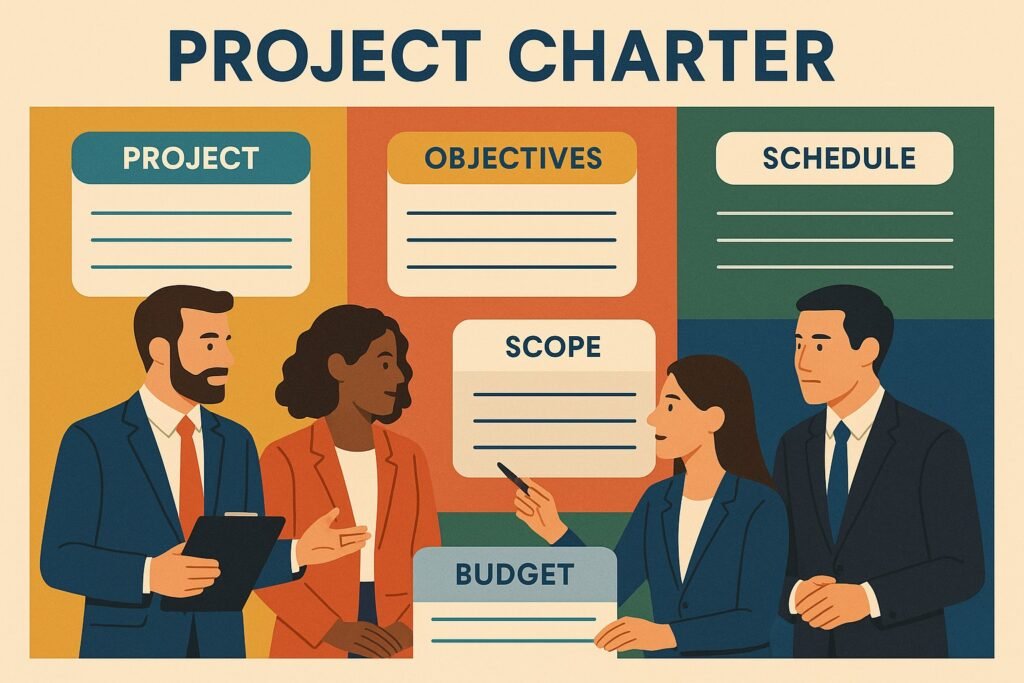
The Purpose of a Project Charter
The primary purpose of a project charter is to formally authorize the project and grant the project manager the authority to apply organizational resources to achieve defined objectives. It establishes a shared understanding among stakeholders regarding the project’s scope, objectives, constraints, assumptions, and success criteria. By doing so, the charter reduces ambiguity at the outset of the project and provides a stable reference point throughout the delivery lifecycle.
From a governance perspective, the project charter serves as a decision-support document for executives and steering committees. It enables leadership to assess whether the initiative aligns with strategic objectives, complies with organizational standards, and justifies the required investment. Once approved, the charter becomes a baseline against which changes are evaluated, ensuring that scope, budget, and objectives remain controlled and aligned with business intent.
Why Project Charters Are Critical in Enterprise Environments
In enterprise and regulated environments, project charters play a vital role in maintaining discipline, accountability, and transparency. Large organizations typically manage extensive portfolios of initiatives competing for limited resources. The project charter provides a consistent mechanism to evaluate, prioritize, and authorize work, ensuring that only strategically aligned and value-driven initiatives move forward.
Project charters also support regulatory compliance and auditability. By documenting governance structures, approval authorities, and compliance considerations, the charter creates an auditable trail that demonstrates due diligence and control. This is particularly important in industries subject to regulatory oversight, where projects must demonstrate adherence to internal policies, external regulations, and risk management frameworks.
How a Project Charter Aligns Strategy and Delivery
A well-defined project charter acts as a bridge between strategic intent and operational execution. It translates high-level business objectives into clearly articulated project goals and boundaries that delivery teams can act upon. By explicitly linking the project to enterprise strategy, the charter ensures that delivery efforts remain focused on outcomes that matter to the organization.
This alignment is especially important in complex organizations where multiple stakeholders, business units, and vendors are involved. The project charter establishes a single source of truth that aligns expectations, clarifies decision rights, and reduces the risk of misalignment between business leadership and delivery teams. It ensures that the project remains anchored to its original purpose, even as conditions evolve.
The Role of the Project Charter in Governance and Control
The project charter is a cornerstone of effective project governance. It defines the governance structure, including executive sponsorship, steering committees, escalation paths, and approval thresholds. This clarity enables timely and informed decision-making and ensures that issues and risks are escalated appropriately.
In addition, the charter establishes the framework for change control by defining baseline scope, objectives, and constraints. Any proposed changes can be assessed against the approved charter to determine their impact on business value, cost, risk, and alignment. This disciplined approach helps prevent uncontrolled scope expansion and protects the integrity of the project.
When a Project Charter Is Created and Used
A project charter is created during the initiation phase of the project lifecycle, before detailed planning or execution begins. In mature PMO environments, no project activity is permitted until the charter has been formally reviewed and approved. This ensures that strategic alignment, funding, and governance are established before resources are committed.
Once approved, the project charter remains an active reference document throughout the project lifecycle. It is reviewed at key governance checkpoints, referenced during change control decisions, and used as a benchmark during audits or assurance reviews. Even after project closure, the charter may be retained as part of the project record to support benefits realization tracking and organizational learning.
Project Charters as a Foundation for Successful Delivery
Ultimately, the project charter provides the structural foundation upon which successful project delivery is built. It creates clarity, alignment, and accountability from the outset, reducing the likelihood of misunderstandings and rework later in the lifecycle. By formally defining purpose, authority, and expectations, the charter enables project managers and teams to operate with confidence and direction.
For large organizations managing complex initiatives, the project charter is not merely a formality but a strategic instrument. When developed thoughtfully and approved rigorously, it significantly increases the likelihood that projects will deliver intended outcomes, realize business value, and support long-term organizational objectives.
Project Charter Template
(Enterprise / Corporate Version)
1. Project Overview
1.1 Project Title
Provide a clear, concise project name that reflects the business outcome rather than the technical solution.
Example:
Enterprise Resource Planning (ERP) Modernization Program – Phase 1
1.2 Project Identifier
A unique identifier aligned to portfolio, program, or financial tracking systems.
Example:
PRJ-IT-2026-014
1.3 Project Sponsor
Name, title, and business unit of the executive accountable for project success and benefits realization.
1.4 Project Manager
Name, role, authority level, and reporting line.
1.5 Date of Charter Approval
Document version and approval date.
1.6 Charter Version Control
| Version | Date | Description | Author | Approval |
|---|
2. Business Context and Strategic Alignment
2.1 Business Background
Describe the organizational context driving this initiative. This should include market conditions, internal performance gaps, regulatory pressures, or strategic shifts.
Address the following areas as applicable:
- Current state challenges
- Competitive landscape
- Regulatory or compliance drivers
- Organizational constraints
2.2 Strategic Alignment
Demonstrate how the project aligns with enterprise strategy, corporate objectives, or portfolio priorities.
Examples include:
- Digital transformation roadmap
- Cost optimization strategy
- Customer experience improvement
- Risk reduction and compliance mandates
Explicitly map alignment to enterprise strategy, objectives, or OKRs where possible.
2.3 Business Drivers
List the key drivers prompting this project. These may include operational inefficiencies, technology obsolescence, regulatory compliance requirements, revenue growth opportunities, or risk mitigation imperatives.
3. Problem Statement
Clearly articulate the problem the project is intended to solve. This statement should be factual, measurable, and business-focused.
A well-structured problem statement typically includes:
- Description of the current state
- Impact on business performance, risk, cost, or compliance
- Consequences of inaction
Avoid introducing solution concepts in this section.
4. Project Purpose and Objectives
4.1 Project Purpose
Define why the project exists, expressed in business terms and aligned to strategic intent.
4.2 Project Objectives
List measurable objectives using SMART criteria.
Examples include:
- Reduce operational processing time by 30 percent within six months of implementation
- Achieve regulatory compliance with XYZ standard by Q4
- Decommission legacy systems by a defined milestone
4.3 Success Criteria
Define what constitutes success from executive, operational, and customer perspectives, including delivery performance, value realization, and adoption outcomes.
5. Scope Definition
5.1 In-Scope
Explicitly define what is included in the project, such as specific business processes, systems or platforms, geographic regions, and organizational units.
5.2 Out-of-Scope
Clearly state what is excluded from the project to prevent ambiguity and scope creep.
5.3 Assumptions
List key assumptions that underpin project planning, resourcing, cost estimates, and delivery approach.
5.4 Constraints
Document known constraints, including budget caps, regulatory deadlines, resource limitations, fixed timelines, or mandated technologies.
6. Deliverables and Milestones
6.1 Key Deliverables
List the tangible outputs the project will produce.
| Deliverable | Description | Owner | Acceptance Authority |
|---|
6.2 Milestone Schedule
Provide a high-level timeline with major phase gates and decision points.
| Milestone | Target Date | Approval Authority |
|---|
7. Stakeholder Identification and Governance
7.1 Key Stakeholders
Identify stakeholders with decision-making authority, influence, or material interest in the project.
| Stakeholder | Role | Interest | Influence |
|---|
7.2 Governance Structure
Define the project’s decision-making and oversight structure, including executive sponsorship, steering committees, PMO oversight, and delivery teams. Clearly outline escalation paths and approval thresholds.
7.3 Roles and Responsibilities
Summarize accountability and responsibility using a RACI or equivalent model.
8. Project Approach and Methodology
8.1 Delivery Methodology
Specify the delivery methodology and rationale, such as Waterfall, Agile, Hybrid, or SAFe / Enterprise Agile.
8.2 High-Level Work Breakdown
Outline major delivery phases, which may include initiation, planning, design, build, test, deploy, and transition.
8.3 Change Control Approach
Describe how changes to scope, cost, schedule, or quality will be assessed, approved, and controlled.
9. Resource and Budget Overview
9.1 Resource Model
Identify required skills and roles, including internal resources, external vendors, and consultants.
9.2 Budget Summary
Provide a high-level financial overview.
| Cost Category | Estimated Cost |
|---|---|
| Internal Labor | |
| External Services | |
| Technology | |
| Contingency |
9.3 Financial Controls
Describe how project costs will be tracked, reported, and controlled throughout the lifecycle.
10. Risk and Issue Management
10.1 Initial Risk Assessment
Identify high-level risks at project initiation.
| Risk | Impact | Probability | Mitigation |
|---|
10.2 Issue Management
Outline processes for issue identification, escalation, decision-making, and resolution.
10.3 Dependency Management
Document key dependencies on other projects, vendors, regulatory approvals, or business readiness activities.
11. Quality Management
11.1 Quality Objectives
Define quality expectations aligned with enterprise standards, policies, and regulatory requirements.
11.2 Quality Assurance Approach
Describe quality controls such as review cycles, phase-gate approvals, audits, and independent assurance activities.
11.3 Acceptance Criteria
Define how deliverables will be validated, accepted, and formally approved.
12. Communications Management
12.1 Communication Objectives
Ensure transparency, alignment, and appropriate executive visibility throughout the project.
12.2 Communication Plan (High-Level)
| Audience | Frequency | Channel | Owner |
|---|
12.3 Reporting Cadence
Specify reporting formats such as status reports, executive dashboards, and KPI tracking.
13. Change Management and Adoption
13.1 Organizational Impact
Assess how the project impacts people, processes, and technology.
13.2 Change Management Strategy
Outline the approach to stakeholder engagement, communications, training, and resistance management.
13.3 Training and Enablement
Describe training requirements, delivery methods, and enablement activities.
14. Compliance, Security, and Controls
14.1 Regulatory Considerations
Identify applicable laws, regulations, standards, and internal policies.
14.2 Data Privacy and Security
Describe how data protection, cybersecurity, and information security requirements will be addressed.
14.3 Audit and Control Requirements
Define audit checkpoints, evidence requirements, and control documentation expectations.
15. Benefits Realization
15.1 Expected Benefits
List anticipated tangible and intangible benefits.
15.2 Benefit Owners
Assign accountability for benefits realization following project delivery.
15.3 Measurement Approach
Define KPIs, baselines, and benefit tracking timelines.
16. Project Exit Criteria
Define the conditions required to formally close the project, including accepted deliverables, transition to operations, initiation of benefits tracking, and completion of lessons learned.
17. Approval and Authorization
By approving this Project Charter, the undersigned authorize the project to proceed and commit organizational resources as outlined.
17.1 Approval Signatures
| Name | Role | Signature | Date |
|---|
18. Appendices
Appendix A – Glossary
Define key terms and acronyms.
Appendix B – Reference Documents
List related business cases, strategies, policies, and standards.
Appendix C – Assumptions Log
Document detailed assumptions and validation owners.
Closing Statement
This Project Charter formally establishes the authority, scope, governance, and strategic intent of the project. It serves as the foundational agreement between business leadership, delivery teams, and stakeholders, ensuring alignment, accountability, and disciplined execution throughout the project lifecycle.
Frequently Asked Questions – Project Charter Template for PMOs and Enterprise Projects
What is a project charter and why is it important in large organizations?
A project charter is a formal document that authorizes a project and defines its purpose, scope, objectives, governance, and authority. In large organizations, the project charter is essential because it establishes executive sponsorship, aligns the initiative with enterprise strategy, and provides a clear mandate for funding, resourcing, and decision-making. Without a formally approved charter, projects often suffer from unclear ownership, weak governance, and uncontrolled scope changes.
Who is responsible for approving a project charter?
In enterprise environments, project charters are typically approved by the executive sponsor and, where applicable, a steering committee or portfolio governance body. Approval confirms that the project aligns with strategic priorities, has secured appropriate funding, and meets governance and compliance standards. While the project manager prepares the charter, final approval authority rests with senior leadership.
What is the difference between a project charter and a business case?
A business case explains why an initiative should be undertaken by evaluating costs, benefits, risks, and alternatives. A project charter formally authorizes the project and defines how it will be governed and delivered. In large organizations, the business case is usually approved first, followed by the project charter as the official initiation document.
When should a project charter be created?
A project charter should be developed during the initiation phase, before detailed planning or execution begins. In PMO-governed organizations, no project work should proceed until the charter has been reviewed and approved. This ensures strategic alignment, funding clarity, and governance controls are established from the outset.
How detailed should a project charter be?
In enterprise environments, a project charter should provide sufficient detail to define scope boundaries, objectives, assumptions, constraints, governance structures, funding parameters, risks, and success criteria. While it should not replace detailed project plans, it must enable executive decision-making and satisfy audit and assurance requirements.
Is a project charter required for Agile projects?
Yes, project charters remain relevant for Agile and hybrid delivery models in large organizations. Although Agile emphasizes working software over documentation, enterprises still require formal authorization, funding approval, and governance clarity. Agile project charters are typically lighter in format but serve the same purpose of alignment and accountability.
What should be included in an enterprise project charter?
An enterprise project charter typically includes the project purpose, objectives, scope definition, assumptions and constraints, key deliverables, high-level milestones, budget overview, governance structure, stakeholder identification, risk considerations, compliance requirements, and approval authorities. These elements ensure controlled and aligned delivery.
How does a project charter support governance and compliance?
The project charter defines decision-making authority, escalation paths, and approval thresholds, which are critical for governance in large organizations. In regulated environments, it also documents compliance obligations, audit requirements, and control frameworks, making it a key reference document during assurance reviews.
Can a project charter be changed once approved?
Yes, but changes to an approved project charter must follow formal change control procedures. Material changes to scope, budget, objectives, or governance usually require re-approval by the sponsor or steering committee. Maintaining version control ensures traceability and audit compliance.
What happens if a project does not have a charter?
Projects without an approved charter often lack strategic alignment, clear authority, and governance oversight. This significantly increases the risk of scope creep, budget overruns, stakeholder conflict, and failure to realize benefits. In mature PMO environments, projects without charters are commonly paused or rejected.
How does a project charter differ from a project plan?
A project charter defines the purpose, objectives, and authority of the project, while a project plan details how the work will be executed, scheduled, and resourced. The charter is created first and provides the foundation upon which all planning and delivery activities are based.
Who owns the project charter after approval?
The executive sponsor retains ownership of the project charter after approval, while the project manager is responsible for maintaining it and ensuring ongoing alignment. The charter remains an active reference throughout the project lifecycle and is often reviewed at governance checkpoints.
Discover more great project charter insights at Wrike https://www.wrike.com/project-management-guide/faq/what-is-a-project-charter-in-project-management/
Explore Our the Latest Trends with Project Management Blogs:
https://pmresourcehub.com/service-delivery-project-dashboards-that-monitor-progress-effectively/
https://pmresourcehub.com/construction-project-reporting-that-drives-action/
https://pmresourcehub.com/15-project-reporting-mistakes-that-undermine-executive-confidence/
https://pmresourcehub.com/3-ways-to-allocate-resources-an-ultimate-guide-to-optimize-resources/
https://pmresourcehub.com/the-project-managers-guide-to-environmental-impact-assessments-eia/
https://pmresourcehub.com/how-to-manage-projects-with-regulatory-oversight-a-strategic-guide/
https://pmresourcehub.com/how-to-boost-productivity-with-kanban-boards/
https://pmresourcehub.com/5-essential-templates-every-project-manager-should-use/
https://pmresourcehub.com/how-to-lead-waterfall-projects-successfully-a-strategic-guide/
https://pmresourcehub.com/plm-vs-erp-enhancing-product-development-and-business-efficiency/
https://pmresourcehub.com/economic-transformation-programme-reshaping-value-creation/
https://pmresourcehub.com/pmtool-tips-for-successful-implementation-in-your-team/
https://pmresourcehub.com/integrated-workplace-management-software-the-future-of-asset-management/