
Earned Value Analysis Tips for Project Managers
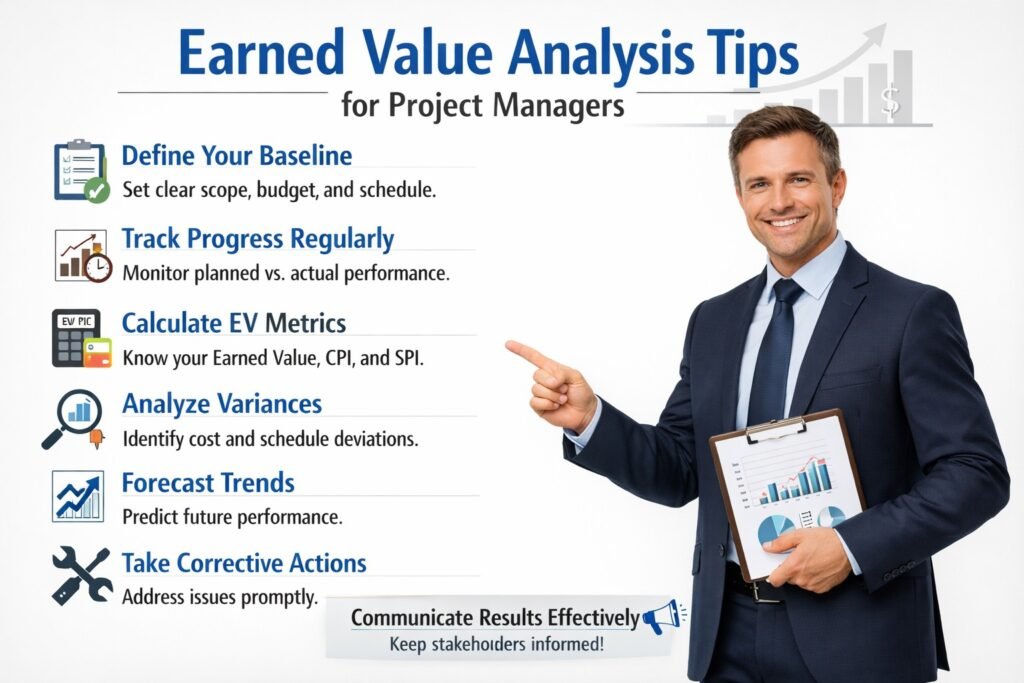
Earned Value Analysis (EVA) is a powerful tool often overlooked by managers aiming to enhance project performance. Its comprehensive approach allows for tracking progress and performance holistically, navigating beyond the surface-level metrics. This article delves into various aspects of EVA, providing actionable insights and tips for project managers to better implement this valuable methodology. Whether you’re a seasoned project manager or new to the concept, mastering EVA can significantly improve project outcomes.
Understanding the Basics of Earned Value Analysis for Project Managers
Earned Value Analysis is a project management technique that integrates project scope, schedule, and cost for a comprehensive assessment. At its core, EVA provides managers with a quantitative way to evaluate project performance. It requires tracking three key metrics: Planned Value (PV), Earned Value (EV), and Actual Cost (AC). PV represents the value of work that was planned to be completed at a specific time, while EV indicates the value of work that has actually been completed. AC, on the other hand, shows the actual costs incurred for the work performed.
To effectively utilize EVA, project managers should focus on the relationships between these metrics. The Cost Performance Index (CPI) and Schedule Performance Index (SPI) can be derived from these values, revealing efficiency rates for cost and schedule performance. CPI is calculated as EV divided by AC, while SPI is EV divided by PV. Understanding these indices allows managers to identify whether a project is on track or if corrective actions are needed.
Incorporating EVA into project management practices may seem daunting at first, but breaking the process down can simplify implementation. Project Managers should prioritize setting clear project objectives and milestones that can be easily tracked. Once those are established, collecting data regularly and updating the metrics will help maintain an accurate snapshot of project health. This proactive approach ensures managers can address any potential issues before they escalate.
Key Benefits of Using Earned Value Analysis in Projects
One of the primary benefits of EVA is its ability to provide early warning signals regarding project performance. By continuously monitoring EV, PV, and AC, managers gain insights that allow them to identify discrepancies before they become significant problems. This early detection capability empowers managers to make informed decisions and redirect resources effectively, minimizing the risk of project overruns.
Additionally, EVA promotes clear communication among stakeholders. Using standardized metrics to evaluate performance can simplify the reporting process and provide a common language for discussing project status. This clarity helps eliminate misunderstandings and fosters collaboration among team members, stakeholders, and clients. As a result, it becomes easier to manage expectations and facilitate discussions around project progress and challenges.
Another substantial advantage of EVA is its role in enhancing resource allocation. With a clear understanding of where a project stands, managers can identify areas that may require additional resources or expertise. This optimization can lead to better financial management and increased overall productivity. By utilizing EVA, organizations can ensure that their resources are deployed where they can have the most significant impact, ultimately improving project outcomes.
Essential Metrics to Track in Earned Value Analysis
Beyond the foundational metrics of Planned Value, Earned Value, and Actual Cost, there are several essential metrics that managers should track to gain deeper insights into project performance. The first is the Cost Variance (CV), which is the difference between EV and AC. A positive CV indicates that the project is under budget, while a negative CV signifies a cost overrun. Understanding CV enables managers to make timely adjustments to keep the project within budget.
Similarly, Schedule Variance (SV) is another critical metric that reflects the difference between EV and PV. A positive SV suggests that the project is ahead of schedule, while a negative SV indicates delays. By closely monitoring SV, managers can proactively manage project timelines and resources to mitigate any potential schedule-related risks.
Lastly, managers should also consider the Estimate at Completion (EAC), which provides a forecast of the total cost of the project based on current performance. It can be calculated using several methods, including the formula EAC = AC + (BAC – EV) / CPI. This metric helps managers predict future spending and make more informed budgetary decisions, ensuring projects remain financially viable.
Common Pitfalls to Avoid in Earned Value Analysis
While Earned Value Analysis has many benefits, it can also lead to pitfalls if not approached correctly. One common mistake is relying too heavily on EVA metrics without considering the broader context of the project. Managers should remember that EVA is just one tool among many in a project manager’s toolkit. Overemphasis on metrics can lead to tunnel vision, causing managers to overlook qualitative factors that may impact project success.
Another common pitfall is failing to establish a baseline before the project begins. Without a clear baseline, it becomes challenging to measure performance accurately. Managers should ensure that they set realistic and achievable baselines that reflect project scope, schedule, and cost. This foundational step is crucial for effective EVA implementation and overall project management success.
Lastly, many managers underestimate the importance of continuous training and knowledge-sharing within their teams. EVA is a specialized skill that may not be familiar to all team members. Investing in training sessions and workshops can improve overall team competency and enhance the effectiveness of EVA within the organization. By fostering a culture of learning, managers can ensure that the team is well-equipped to leverage EVA effectively.
Tips for Integrating Earned Value Analysis into Your Workflow
To integrate EVA successfully into your project management workflow, start by educating the team about its benefits and importance. Conduct training sessions that cover the fundamental concepts and metrics involved in EVA. Creating a culture of understanding and appreciation for analytics can enhance buy-in from team members, making it easier to implement this methodology.
Next, establish clear processes for regular data collection. This might include setting up automated tracking tools or dashboards that provide real-time insights into project performance. By ensuring that data is collected consistently, managers can maintain an accurate picture of project health and make better-informed decisions.
Finally, make EVA part of your regular project review meetings. Integrating these discussions into your workflow allows the team to analyze performance metrics regularly and adjust project plans proactively. By consistently reviewing EVA data, managers can adapt strategies as needed, ensuring that the project remains aligned with both goals and budgets.
How to Communicate Earned Value Analysis Results to Stakeholders Effectively
Effectively communicating EVA results to stakeholders is essential for maintaining transparency and trust. Start by tailoring communication to the audience. Stakeholders may have varying levels of understanding regarding EVA metrics, so it’s important to present information in a way that is clear and relevant to them. Simplifying complex metrics into easy-to-understand visuals, such as graphs or charts, can be a valuable strategy.
Next, focus on storytelling. Rather than simply presenting numbers, frame the data within the context of the project’s narrative. Use EVA metrics to illustrate the progress made, challenges encountered, and strategies employed to mitigate risks. This storytelling approach helps stakeholders grasp the bigger picture, enabling them to appreciate the nuances behind the metrics.
Finally, encourage feedback and discussion during presentations. Stakeholders may have valuable insights or questions that can lead to a more comprehensive understanding of project performance. Creating an open dialogue fosters collaboration and allows for a more nuanced approach to project management, ultimately leading to better outcomes for all involved.
Leveraging Software Tools for Earned Value Analysis
In today’s fast-paced project management landscape, leveraging software tools can enhance the effectiveness of Earned Value Analysis. Many project management software solutions offer built-in EVA functionalities, allowing managers to track key metrics easily. Tools like Microsoft Project, Primavera P6, and other specialized software can automate data collection and reporting, saving valuable time and reducing manual errors.
When selecting a software tool, consider one that provides customizable dashboards and reporting features. This flexibility enables managers to adapt the tool to their specific needs and preferences, ensuring a more tailored experience. Moreover, a user-friendly interface can help team members engage with the tool more effectively, increasing overall adoption and utilization.
Additionally, ensure that the chosen software integrates seamlessly with other tools used by your organization. Effective integration allows for better data flow and reduces the likelihood of discrepancies between different systems. By leveraging software tools, managers can not only simplify the EVA process but also enhance collaboration and communication across their teams.
Best Practices for Continuous Improvement in Earned Value Analysis Usage
Continuous improvement should be a core aspect of any organization’s EVA practices. Start by regularly reviewing and updating your EVA processes to incorporate lessons learned from past projects. Gathering feedback from team members about what worked and what didn’t can provide valuable insights that inform future EVA implementations.
Another best practice is to benchmark EVA performance against industry standards. Engaging with external resources and experts can reveal best practices from other organizations, enabling you to refine your own processes. This external perspective can spark innovation and lead to more effective project management strategies.
Finally, foster a culture of accountability and ownership within your team. Encourage team members to take responsibility for their roles in the EVA process. This sense of ownership can lead to increased commitment to data accuracy and performance improvement. By embedding continuous improvement into your organization’s culture, you can ensure that EVA remains a dynamic and effective tool for project management success.
FAQ: Earned Value Analysis (EVA) for Project Managers
What is Earned Value Analysis (EVA) and why is it important in project management?
Earned Value Analysis, often abbreviated as EVA, is a project management methodology that integrates scope, schedule, and cost to provide a comprehensive view of project performance. Unlike traditional tracking methods, EVA enables managers to quantify progress and efficiency rather than rely solely on milestone completion or expenditure tracking.
The importance of EVA lies in its ability to provide early warning signals of project deviations. By comparing planned value (PV), earned value (EV), and actual cost (AC), project managers gain a real-time understanding of both schedule and budget performance. This allows for proactive decision-making and helps mitigate risks before they escalate into significant problems.
Organizations that implement EVA consistently often see enhanced project transparency, improved resource allocation, and better alignment between project objectives and organizational goals. The methodology transforms project oversight from reactive to strategic, empowering managers to steer projects toward success.
How do Planned Value (PV), Earned Value (EV), and Actual Cost (AC) work together in EVA?
Planned Value (PV) represents the budgeted value of work that should have been completed by a specific point in the project timeline. It establishes the baseline for performance comparison and helps managers track whether the project is progressing as scheduled.
Earned Value (EV) measures the value of actual work completed at a given time. Unlike simple percentage completion, EV translates project progress into a financial equivalent, offering a concrete measure of productivity and effectiveness.
Actual Cost (AC) reflects the total expenditure incurred for the completed work. Comparing AC to EV reveals whether the project is over or under budget. When used together, PV, EV, and AC allow project managers to calculate critical indices such as the Cost Performance Index (CPI) and Schedule Performance Index (SPI), providing actionable insights into cost efficiency and schedule adherence.
What are the Cost Performance Index (CPI) and Schedule Performance Index (SPI), and why do they matter?
The Cost Performance Index (CPI) is calculated as the ratio of EV to AC. It indicates the efficiency of cost utilization in a project. A CPI greater than 1 suggests the project is under budget, while a CPI below 1 highlights overspending issues that require corrective measures.
The Schedule Performance Index (SPI) is derived from the ratio of EV to PV. SPI measures how closely the project is adhering to its planned schedule. An SPI greater than 1 indicates the project is ahead of schedule, whereas an SPI less than 1 signals delays that need attention.
Both indices are essential for project monitoring because they provide a quantifiable measure of efficiency. By analyzing CPI and SPI, managers can prioritize corrective actions, allocate resources more effectively, and identify whether deviations are cost-related, schedule-related, or both.
How can project managers implement EVA effectively in their projects?
Effective implementation of EVA starts with clearly defined project objectives and measurable milestones. Without clear benchmarks, calculating PV, EV, and AC becomes imprecise and reduces the utility of EVA metrics.
Regular data collection and metric updates are critical. Managers should ensure that work progress and costs are documented consistently, allowing for accurate calculation of indices and timely identification of variances.
Training the project team to understand EVA terminology and methodology is also crucial. Teams that understand how their work contributes to EV are more likely to accurately report progress and collaborate effectively.
In addition, integrating EVA into project management software can automate calculations and generate visual reports. Dashboards highlighting CPI, SPI, and variance trends make it easier for stakeholders to interpret data quickly and make informed decisions.
What are the key benefits of using EVA in enterprise projects?
Earned Value Analysis offers multiple advantages for enterprise-level project management. First, it provides a comprehensive view of project performance by integrating cost, schedule, and scope. This holistic perspective is particularly valuable in complex projects where multiple teams and resources are involved.
Second, EVA supports early detection of project deviations. Managers can identify cost overruns or schedule slippages before they become critical, allowing for timely interventions. This proactive management reduces the risk of project failure and improves overall delivery success rates.
Third, EVA enhances accountability. By quantifying performance against predefined metrics, team members understand the impact of their work on project outcomes. This promotes ownership and encourages efficient execution.
Finally, EVA facilitates strategic decision-making. Data-driven insights help managers prioritize actions, reallocate resources, and communicate performance transparently to stakeholders, improving trust and alignment across the organization.
How does EVA help with forecasting and project control?
One of the unique advantages of EVA is its ability to support forecasting and predictive analysis. By examining current CPI and SPI values, managers can estimate the cost at completion (EAC) and projected project duration.
Forecasting allows managers to anticipate potential budget or schedule issues and take corrective measures proactively. For example, if SPI indicates delays, additional resources can be allocated, or scope adjustments can be considered to maintain project timelines.
Additionally, EVA provides variance analysis, which quantifies deviations between planned and actual performance. Understanding these variances enables project managers to implement targeted corrective actions, enhancing project control and reducing uncertainty.
What challenges might organizations face when implementing EVA?
Despite its benefits, EVA can present challenges if not implemented correctly. One common issue is inaccurate or inconsistent data collection, which undermines the reliability of CPI and SPI metrics. Without accurate data, managers may make decisions based on misleading information.
Another challenge is the learning curve associated with EVA. Teams unfamiliar with the methodology may struggle to understand PV, EV, AC, and related indices. Comprehensive training and stakeholder buy-in are essential to overcome this barrier.
Complex projects with dynamic scope changes can also complicate EVA application. Managers need to adjust calculations to reflect approved changes and ensure that EV reflects true progress. Regular updates and revisions are critical to maintain the accuracy and usefulness of EVA insights.
How can EVA improve stakeholder communication?
EVA facilitates transparent and data-driven communication with stakeholders. By presenting project performance in quantifiable terms, managers can provide clear updates on progress, budget adherence, and schedule compliance.
Dashboards and visual reports generated from EVA data can show trends, highlight risks, and demonstrate corrective actions, making it easier for executives to make informed decisions. Stakeholders gain confidence when they see objective metrics rather than subjective progress reports, improving trust and alignment across teams.
What industries or project types benefit most from EVA?
EVA is particularly valuable in industries with complex projects, tight budgets, and critical deadlines. Construction, engineering, IT, aerospace, and large-scale corporate initiatives often benefit the most from EVA.
Any project that involves multiple interdependent tasks, resource constraints, and high stakeholder expectations can leverage EVA to enhance performance monitoring. The methodology is also useful for government or regulatory projects, where accurate reporting and compliance are essential.
By providing early warnings and measurable performance metrics, EVA allows managers in these industries to mitigate risks, optimize resources, and ensure timely delivery.
Conclusion: Why mastering EVA is essential for project managers
Earned Value Analysis is more than just a project monitoring tool; it is a strategic methodology that drives efficiency, accountability, and performance. By integrating scope, schedule, and cost, EVA provides project managers with a holistic understanding of project health.
Mastering EVA empowers project managers to identify potential issues early, make informed decisions, and communicate effectively with stakeholders. The proactive insights derived from EVA enhance project control, minimize surprises, and support successful project delivery.
In a business landscape defined by complexity and uncertainty, implementing EVA is a critical step for project managers who aim to deliver high-quality outcomes while maintaining budget and schedule integrity. Organizations that embrace EVA as a standard practice position themselves for sustainable project success and operational excellence.
Conclusion
Mastering Earned Value Analysis can significantly impact project performance, providing project managers with insights that lead to better decision-making. By understanding the basics, leveraging metrics, and avoiding common pitfalls, organizations can integrate this powerful methodology into their workflows effectively. With ongoing training, open communication, and a focus on continuous improvement, EVA can transform how projects are managed, ultimately driving success across the enterprise.
Hashtags: #ProjectManagement #EarnedValueAnalysis #PerformanceMetrics #StakeholderEngagement #ContinuousImprovement
External Source: For more insights into Earned Value Management Analysis, visit Deltek
Discover More great insights at https://www.pmresourcehub.com
Explore Free Project Management Templates https://pmresourcehub.com/library/
Explore Agile Blogs https://pmresourcehub.com/agile/